Synagogue Complete
ID: 164
Building type: basilical synagogue
Context:
urban/rural
Site:
Khirbet Wadi Hamam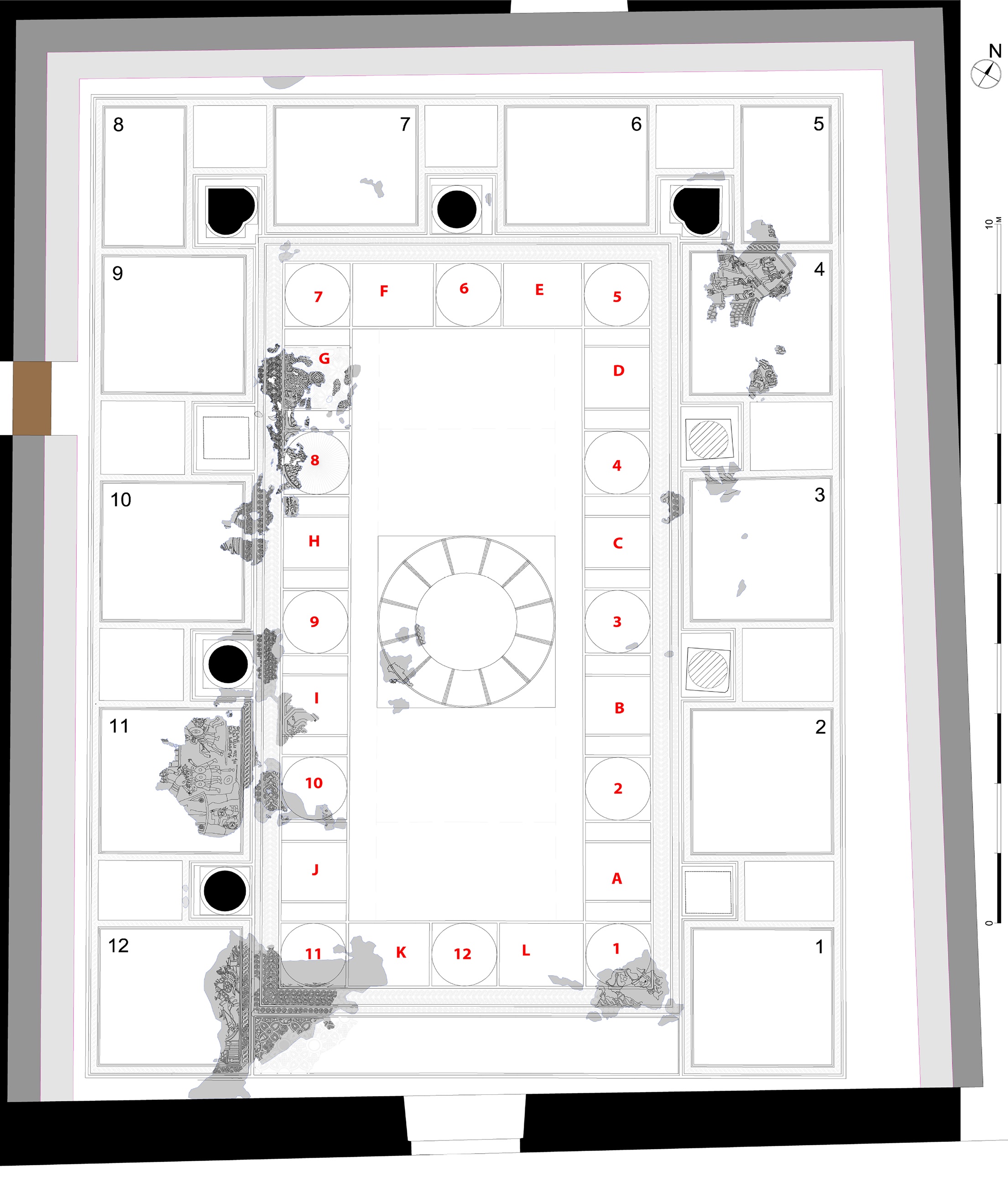
Description:
Set on a man‑made platform rising above the village, the monument dominated its surroundings. Excavations beneath the later synagogue floor revealed that this broad terrace had been leveled, probably in the early first century CE. The earliest architectural traces on the terrace belong to an Early Roman public edifice—possibly already a synagogue—whose initial phase appears to have ended in the final third of the third century CE. A “Galilean”-type synagogue was then erected atop the same platform, following the earlier footprint and overall scheme. In this second phase, basalt benches were added along the interior walls, and the colonnade incorporated limestone shafts and drums reused from the preceding structure. The floor was paved with an extensive mosaic, covering nearly 100 square meters, featuring narrative imagery such as the Tower of Babel and Samson slaying the Philistines. Four inscriptions were included: three dedicatory texts in Aramaic—two positioned in the margins beside narrative panels in the aisles and a third set within a rectangular frame in the broad border encircling the nave—and a fourth inscription, now fragmentary, near the circular central motif of the nave. All four were rendered in black tesserae on a white ground, with uniform letter size and form, indicating execution in a single campaign by one workshop. Late in the fourth century, the building suffered damage, plausibly from the earthquake of 363 CE. Repairs introduced a stone bema and laid plaster flooring where portions of the mosaic had failed; notably, surviving mosaic sections were left visible rather than being entirely overlaid. The structure likely collapsed in the early fifth century. The collapse layer contained hundreds of roof tiles, evidence that supports an earthquake—perhaps in 419 CE—as the cause of the final destruction. The sequence documented here is central to the discussion of dating “Galilean”-type synagogues: this example clearly precedes the rise of imperial Christianity, demonstrating that the architectural tradition was already established in the Roman period, at least by the third century, and did not originate exclusively in the Byzantine era. Plan source: Leibner 2018: 145, fig. 4.1. Further reading: Leibner, U. 2018. Khirbet Wadi Ḥamam: A Roman-Period Village and Synagogue in the Lower Galilee. The Institute of Archaeology, The Hebrew University of Jerusalem. https://scholars.huji.ac.il/uzileibner/wadi-hamam https://synagogues.kinneret.ac.il/synagogues/wadi-hamam/