Monastery Complete
ID: 174
Building type: three-aisled basilica
Context:
rural; monastic
Site:
Kursi; ChorsiaInscriptions:
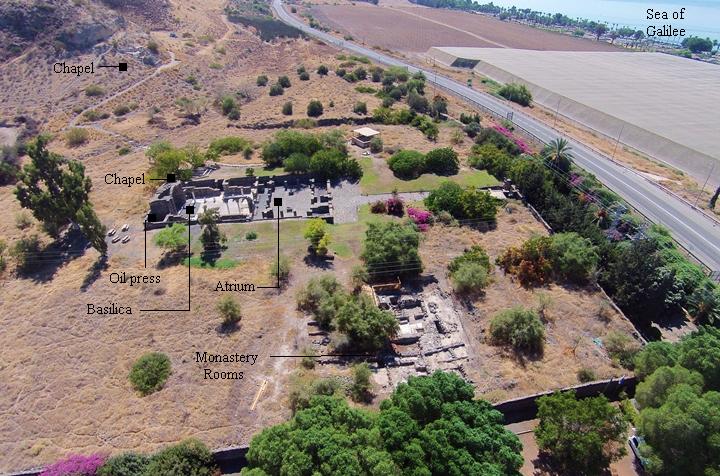
Description:
Encircled by a substantial stone perimeter wall that defines a rectangle roughly 140 by 120 meters, the monastic compound is entered from the west through a gate guarded by a watchtower, facing toward the Sea of Galilee. In antiquity, a paved approach linked this entrance to a small harbor that received Christian pilgrims arriving by boat. Within the enclosure stands the church, approximately 45 by 25 meters. Access to its prayer hall was gained through an atrium created by a colonnaded courtyard. Inside, two parallel arcades—each comprising eight columns—carried marble capitals carved with crosses and articulated the interior into a central nave flanked by two side aisles. The floor was laid with polychrome tesserae; although mosaic pavements survive only in the aisles, vestiges of vegetal and animal imagery remain, including grapes, figs, pomegranates, fish, birds, and waterfowl. Most animal figures were nearly erased, probably by adherents of the iconoclastic movement active in the early Muslim period. At the eastern end, a raised apse is flanked by two square chambers; one functioned as a baptistery, as confirmed by a Greek inscription dedicating it to Abbot Stephanos during the reign of Emperor Mauricius at the close of the sixth century. The earliest construction phase of the church belongs to the late fifth century, while the monastery itself appears firmly established by the sixth century. Image source: https://www.biblewalks.com/kursi Further reading: https://dig.corps-cmhl.huji.ac.il/Monasteries/kursi-gerasa-chorsia-gergesa-monastery https://www.jewishvirtuallibrary.org/kursi-christian-monastery https://www.biblewalks.com/kursi https://architectureandasceticism.exeter.ac.uk/items/show/187