Apollonia; Arsuf; Sozousa Complete
Localization
Site plan
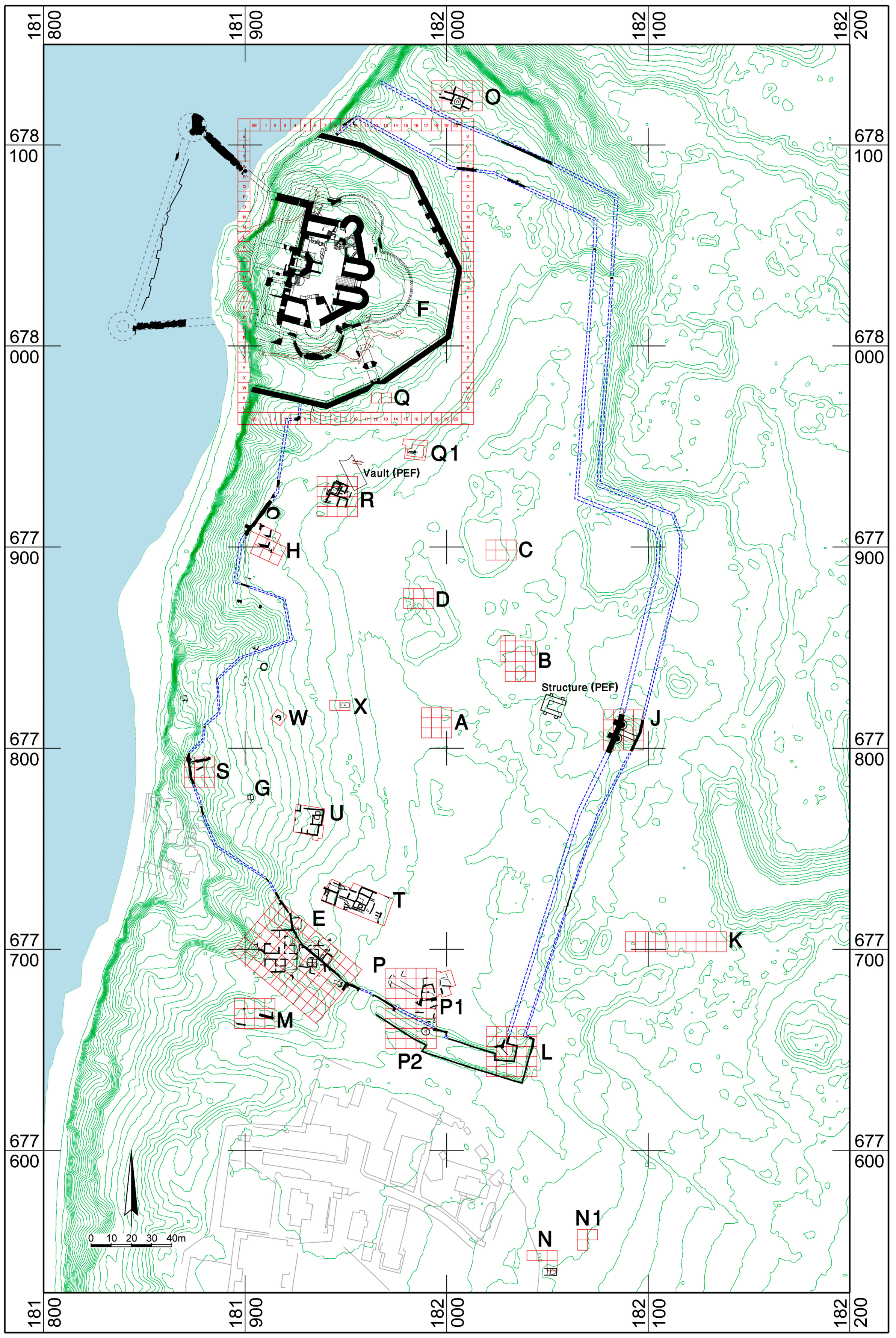
Description
Set on a sandy ridge overlooking the Mediterranean, Apollonia–Arsuf preserves remains from a long sequence of habitation that stretches from the Persian and Hellenistic periods through the Middle Ages. At the southern margin of the ruins (Zone P1), excavators identified a structure interpreted as a synagogue, notable for a bilingual inscription in Greek and Samaritan Aramaic. In late antiquity the settlement was known as Sozousa. During the Byzantine era it lacked defensive walls, yet archaeological evidence indicates that its status in the sixth–seventh centuries CE was considerable, a prominence seemingly sustained by a substantial Samaritan community that remained in place until the Islamic conquest. Under the reign of Caliph ‘Abd al-Malik (685–705) the site was fortified and became a significant ribat, thereafter referred to as Arsuf. Crusader forces captured the town in 1101. A castle was not begun until 1241 and was never brought to completion. The Knights Hospitaller assumed control of the unfinished stronghold in 1261, but a Mamluk siege in 1265 razed both the fortifications and the contemporary town, known then as Arsur. The settlement was not reoccupied thereafter. Investigations have also brought to light a villa from the Roman period within the site. Plan source: Tal 2020, fig. 1. Further reading: Tal, Oren. 2020. "A Samaritan Synagogue of the Byzantine Period at Apollonia-Arsuf/Sozousa?" Religions 11, no. 3: 127. https://doi.org/10.3390/rel11030127 Tal, Oren. 2015. A Bilingual Greek-Samaritan Inscription from Apollonia-Arsuf/Sozousa: Yet More Evidence of the Use of εἷς θεὸς μόνος Formula Inscriptions among the Samaritans. ZPE 194: 169–75.