Bātūtā; El Batoûta Complete
ID: 52
Region/Province: Syria I
Localization
Site plan
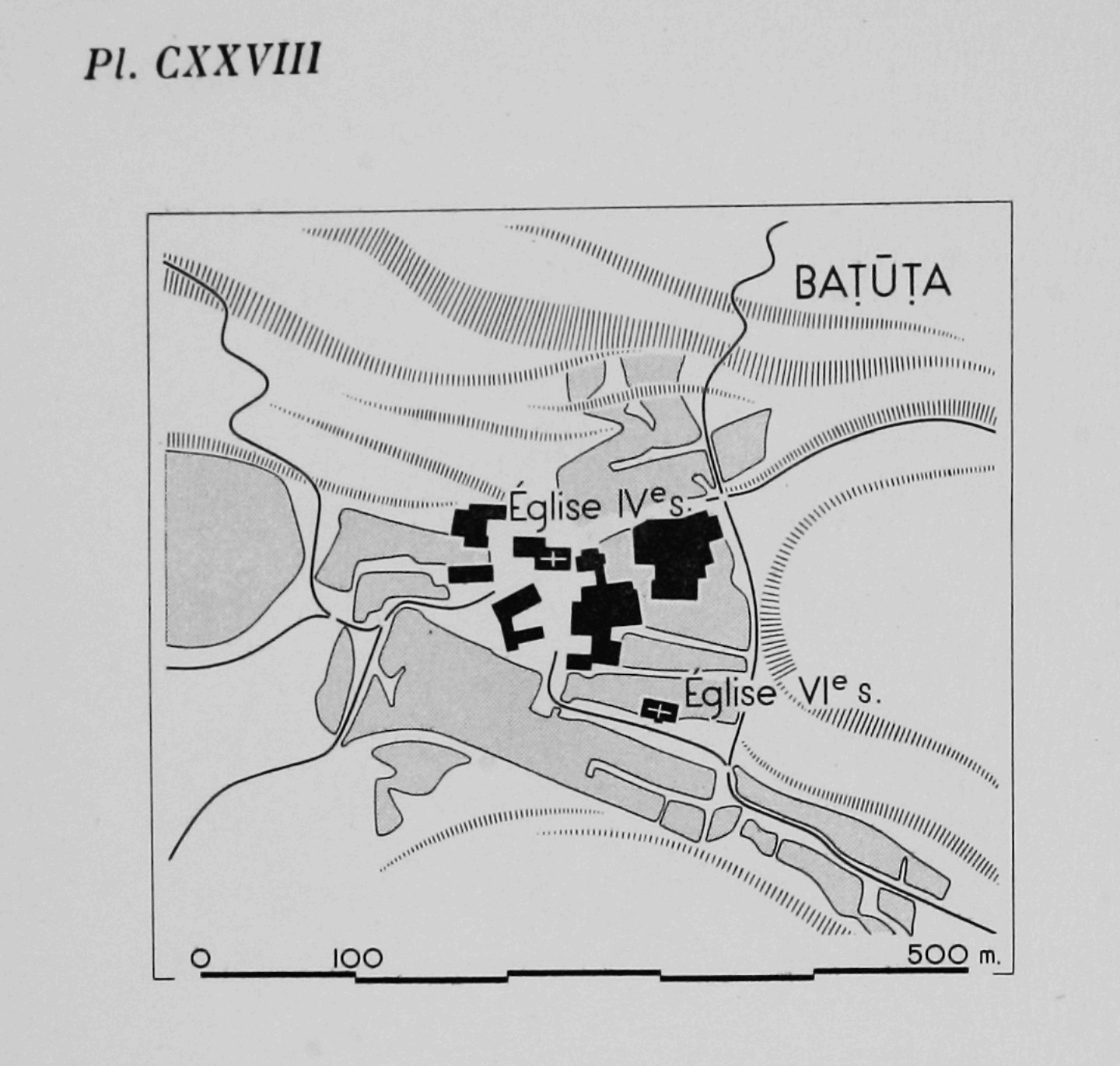
Description
A village in Jabal Simʿān registered in TIB 15 on pp. 995–996 as Bātūtā. Also spelt El Batoûta. As described by Klaus Peter Todt and Bernard Andreas Vest in TIB15, the explorers (especially Butler's Princeton Expedition to Syria, the missions of Georges Tchalenko and more recently of Georges Tate) recorded eighteen houses on site, reportedly none of them was earlier than the fourth century. The site also has a three-aisled basilica which may even be a fourth-century construction, while the other church was built in the sixth century. Among loose architectural elements, architraves are noteworthy. An oil press and a cistern were also found. As for epigraphy, one Syriac graffito with a name was recorded as well as one Greek inscription from a house. The latter gives some historical information on this site, mentioning a certain Marianos and his children, the architect Mariades, and a certain Saakonas. Unfortunately, the reading of its dating formula is very doubtful and may refer to April 363 or 563 CE. Literature (for a fuller list, see the bibliography by Klaus Peter Todt and Bernard Andreas Vest in TIB 15): TIB 15 – Todt, K.P., Vest, B.A., Tabula Imperii Byzantini, vol. 15 (Vienna: Verlag der Österreichischen Akademie der Wissenschaften, 2014, 995–996; H. C. Butler (ed.) Publications of the Princeton University Archaeological Expeditions to Syria in 1905–5 and 1909. Division II: Architecture, Section B: Northern Syria (Leiden: Brill, 1920), 330, 332; Butler, H.C., Smith E.B., Early churches in Syria: fourth to seventh centuries (Amsterdam: Hakkert, 1969), 34, 144, 149; Tchalenko, G. (ed.), Villages antiques de la Syrie du Nord: Le Massif du Bélus a l'époque romaine, vol. 1 (Paris: P. Geuthner, 1953), vol. 1, 296 note 6, 326 note 1, 329 note 2, 333 note 2, 335; vol. 2, Pl. CXXVIII; Tchalenko, G., Églises syriennes à bêma: texte (Paris: P. Geuthner, 1990), 37–40; Strube, Ch., Baudekoration im Nordsyrischen Kalksteingebiet, vol. 1: Kapitell-. Tür- und Gesimsformen des 4. und 5. Jhs. n. Chr. (Mainz: Zabern, 1993), 31–32; Weber, Th. M., "Syrien, Ägypten und Aksum. Das 'sanctuaire carré' – eine Sondernform des Altarraumes in der frühchristlischen Sakralarchitektur Westasiens und Nordostafriaks", in: D. Kreikenbom et al. (ed.), Krise und Kult. Vorderer Orient und Nordafrika von Aurelian bis Justinian (Berlin–New York: Walter de Gruyter, 2010), 231, no. 2.32; Tate, G., Les campagnes de la Syrie du Nord (Beirut: Presses de l’Ifpo, 2013), 179, 209, 282, 318, 319. Inscriptions (listed in TIB 15, pp. 995–996): PAES IVB 60 (Syriac graffito recording the name Stephanos); PAES III B6, 203, no. 1201 [W. K. Prentice (ed.), Publications of the Princeton University Archaeological Expeditions to Syria in 1905–5 and 1909. Division III: Greek and Latin Inscriptions. Section B: Northern Syria (Leiden: Brill, 1922)] = IGLS II 391 (Greek inscription with the names of architects) .