Synagogue Complete
ID: 10
Building type: basilical synagogue
Context:
rural
Site:
Hammat Gader; Emmatha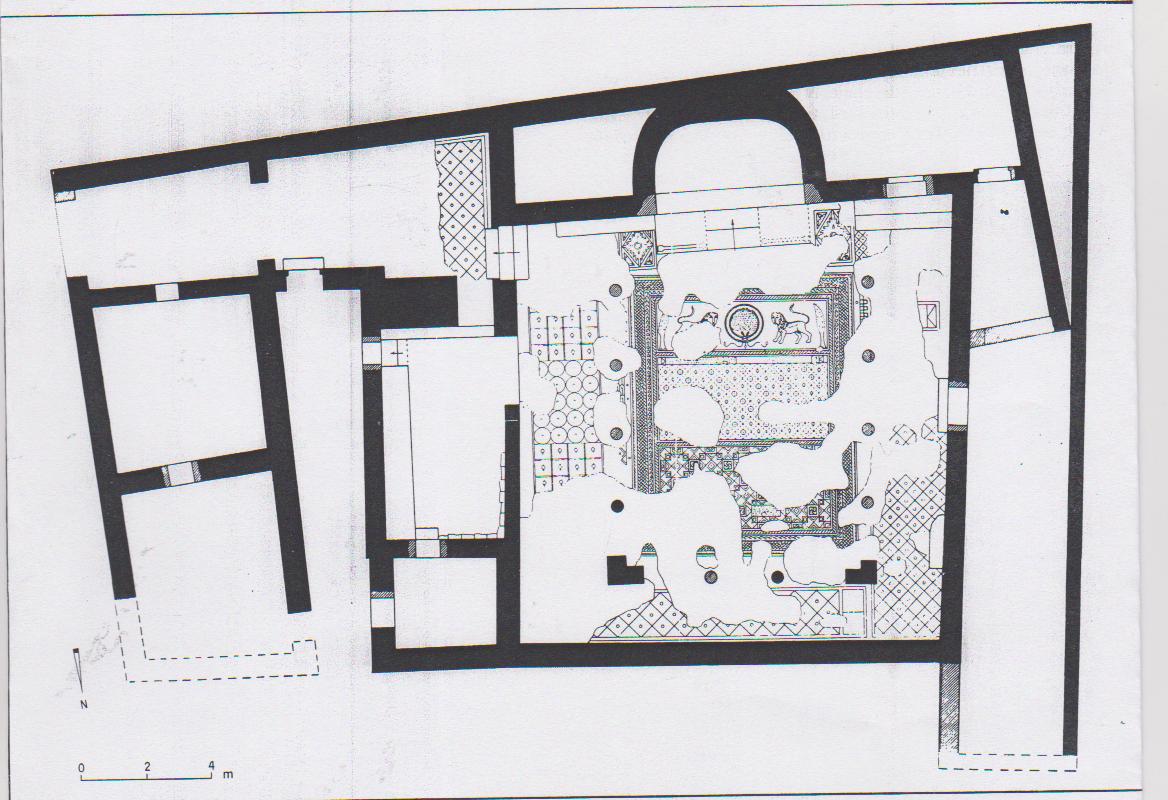
Description:
Beneath the synagogue’s late antique mosaic pavement, two earlier construction phases were detected. The lowest preserved surface, 1.4 m below the synagogue’s floor level, consisted of plain white tesserae. Above it lay a second phase with an opus sectile pavement, dated to the latter half of the fourth century. The construction date of the standing synagogue remains uncertain, but it is generally placed sometime between the fifth and seventh centuries. The principal space is a near-square hall measuring approximately 14 by 13 meters, organized by three longitudinal rows of columns. On the south, oriented toward Jerusalem, a bema stands before an apse. From the collapse debris came fragments of a chancel screen bearing a menorah enclosed within a wreath. Access to the hall was not direct: two approaches through narrow corridors lead into the interior. East of the main space, an ancillary chamber fitted with a stone bench was uncovered; it may have served for instruction or as a women’s prayer room. The hall was originally entirely paved with mosaic, though significant portions are lost. In the central nave, three dominant panels, each framed with guilloche, structure the decorative scheme. Two panels are filled with geometric ornament. The southernmost, nearest the bema, carries the only figural composition: a pair of lions flanking a wreath that encloses an Aramaic inscription. Below this panel, two additional Aramaic texts appear within tabulae ansatae. A fourth Semitic inscription, likewise set in a tabula ansata, occurs in the northernmost panel, slightly west of the pavement’s central axis; a corresponding inscription to the east was likely present but has not survived. All inscriptions were meant to be read while facing the apse and bema. Additional epigraphy may once have existed; only the edge of another tabula ansata is preserved in the western aisle. Site plan: After M. Avi-Yonah, “Hammat Gader, Tell el-Hammeh,” in The New Encyclopedia of Archaeological Excavations in the Holy Land, vol. II, 1993, p. 567; retrieved from https://synagogues.kinneret.ac.il/synagogues/hamat-gader Further reference: M. Avi-Yonah, “Hammat Gader, Tell el-Hammeh,” in The New Encyclopedia of Archaeological Excavations in the Holy Land, vol. II, 1993, pp. 566–569.