Synagogue Complete
ID: 103
Building type: basilical synagogue
Context:
urban
Site:
Gerasa; Jerash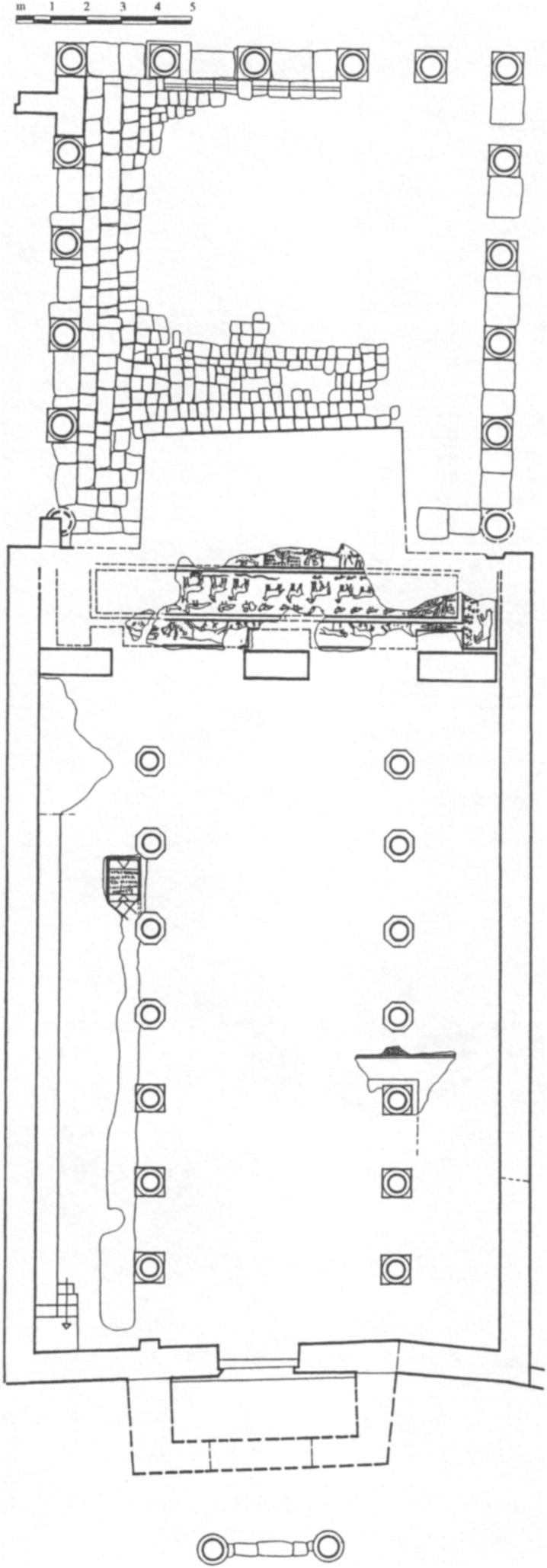
Description:
Beneath a church dated to 530–531 CE, located to the west of the Artemis temenos and partially overlying it, the remains of a synagogue were uncovered. The synagogue was approached from the east, whereas the later church that reused its foundations had its entrance on the west. The synagogue’s narthex lay directly under what became the church’s apse. The narthex pavement carried a mosaic showing animals boarding Noah’s Ark. Among the creatures, two partially preserved human heads appear, identified in Greek as Shem and Japhet, sons of Noah. At the eastern end of the same panel, another Greek inscription is arranged around a menorah. From this narthex, three doorways led into the main hall of the synagogue, which was articulated into a nave and side aisles by two colonnades. Set within the mosaic floor between two columns of the northern colonnade was an Aramaic inscription. The church complex included a courtyard on the western side, while an atrium to the east predated the church and belongs to the third or fourth century. The precise construction date of the synagogue cannot be established; its destruction occurred sometime before 530–531 CE, when the church was erected above it. Plan source: Dvorjetski 2005, 146 (after Piccirillo 1993, 290, fig. 546). Bibliography: Dvorjetski, E. 2005. “The Synagogue-Church at Gerasa in Jordan: A Contribution to the Study of Ancient Synagogues.” Zeitschrift des Deutschen Palästina-Vereins 121: 140–167.