Synagogue Complete
ID: 154
Building type: basilical synagogue
Context:
rural
Site:
'En Nashut; ῾Ein Nashot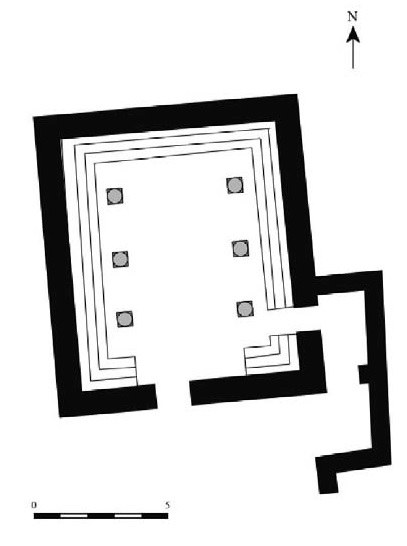
Description:
Excavations at En Nashut uncovered the principal prayer hall, a southeastern annex, the area before the southern entrance, and foundations for a stairway traced along the north and east walls. The prayer hall follows a roughly rectangular layout of approximately 12.5 by 11 m. Five square stylobates survive in the floor; one still carries a column base with part of the shaft. Two parallel rows of three columns each divided the interior into a central nave measuring about 5.25 m in width and flanking aisles. Basalt benches ran continuously along all the walls in three runs. On the south wall, immediately to the left of the main doorway and oriented toward Jerusalem, a negative imprint marks the location of the Ark of the Law. The doorway itself has not been preserved, but its jambs and lintel were recovered nearby; the opening likely measured about 1.2 m wide. The entrance was set slightly west of the longitudinal axis, a displacement that allowed space for the Ark on the southern wall. Walls, benches, and columns were coated with whitewash, and at least one inscription was incised into this plaster. The annex is a side chamber built against the southeastern corner of the hall. Its floor lies roughly 1 m above the level of the synagogue’s main floor, and access was through an opening in the hall’s southeast corner. The building may originally have been preceded by a small roofed portico at the front. Architectural ornamentation at En Nashut is notably abundant, comprising intricate geometric and floral motifs as well as figural imagery, including menorahs, an altar, an amphora, a flower, a pair of facing birds of prey, and a large nine-branched candelabrum. One architrave, recovered in two fragments, carried a relief of a Hercules knot whose terminals were formed as snakes’ heads, flanked by two rosettes; an Aramaic inscription was cut beneath this relief. Another decorated stone preserves reliefs of two menorahs with a lion between them. Fragments suggest that the gable may have borne an eagle with spread wings. The base of the Ark of the Law may have been adorned with a depiction of Daniel in the lions’ den, a scene attested among the remains. A mid-fifth-century date for the construction is supported by a deposit of 191 coins (115 identified) found beneath the paving in front of the main entrance, likely interred during building. Subsequent repairs were undertaken, notably after an earthquake around 551 CE. The synagogue and its associated village were abandoned by the late sixth or the early seventh century CE. Plan source: Milson, D. W. 2007. Art and Architecture of the Synagogue in Late Antique Palestine. In the Shadow of the Church. Leiden, p. 347. Further reading: Gregg, R. C., and D. Urman. 1996. Jews, Pagans, and Christians in the Golan Heights: Greek and Other Inscriptions of the Roman and Byzantine Eras. Atlanta: Scholars Press, pp. 95–99. Hachlili, R. 2013. Ancient Synagogues—Archaeology and Art: New Discoveries and Current Research. Leiden and Boston: Brill, pp. 113–114. Maoz, Z. U. 1993. “En Nashut.” In The New Encyclopedia of Archaeological Excavations in the Holy Land, vol. 2, pp. 412–413. For additional information: https://synagogues.kinneret.ac.il/synagogues/en-nashut/