Synagogue Complete
ID: 170
Building type: basilical synagogue
Context:
urban/rural
Site:
JaphiaInscriptions:
Description:
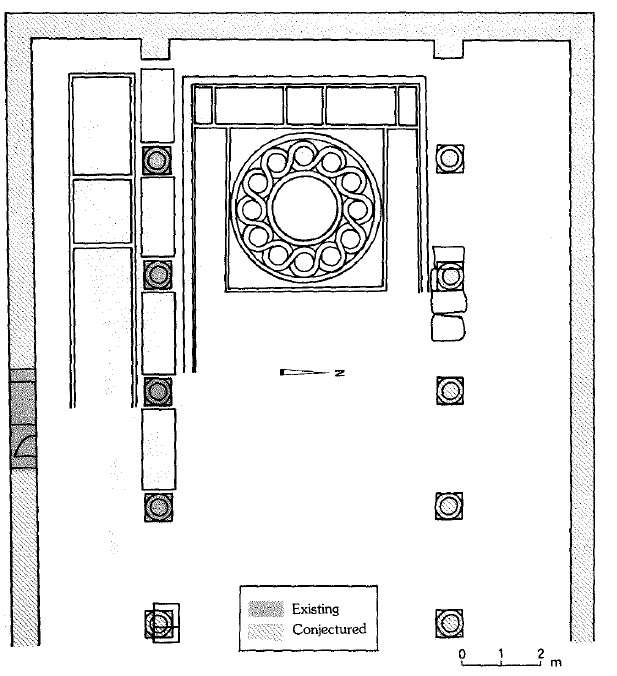
Only a partial ground plan could be reconstructed. The structure measured roughly 19 m in length by 15 m in width and was aligned on an east–west axis; the principal facade appears to have faced east. This orientation contrasts with that of most Galilean synagogues, which customarily faced south toward Jerusalem. Sukenik attributed the deviation to the location of Japhia within the territory of Zebulun, which Genesis 49:13 associates with the Mediterranean coast. No apse, bema, or designated emplacement for the Holy Ark has been identified. Portions of the polychrome mosaic pavement were preserved and documented. The south aisle carried geometric motifs framed by guilloche bands, while the nave featured both animal and vegetal imagery. On stylistic grounds, the mosaics are dated to the late third to fourth century. Near the west end, the central panel consisted of a large circle about 3.8 m in diameter enclosing twelve smaller roundels; although the scheme parallels the zodiac compositions found in many late antique synagogues, the excavators understood it as an allegory of the twelve tribes of Israel. Another fragment in the southwestern part of the nave shows an eagle standing on two pairs of volutes together with a head identified as Helios or Medusa. Source of plan: Barag 1993: 659. Further references: - Barag, D. 1993. “Japhia.” In The New Encyclopedia of Archaeological Excavations in the Holy Land, 659–660. - Milson, D. W. 2007. Art and Architecture of the Synagogue in Late Antique Palestine. In the Shadow of the Church, Leiden, 473. - https://synagogues.kinneret.ac.il/synagogues/japhia/