Monastery Complete
ID: 198
Building type: unknown
Context:
monastic
Site:
Hura (Northen Negev)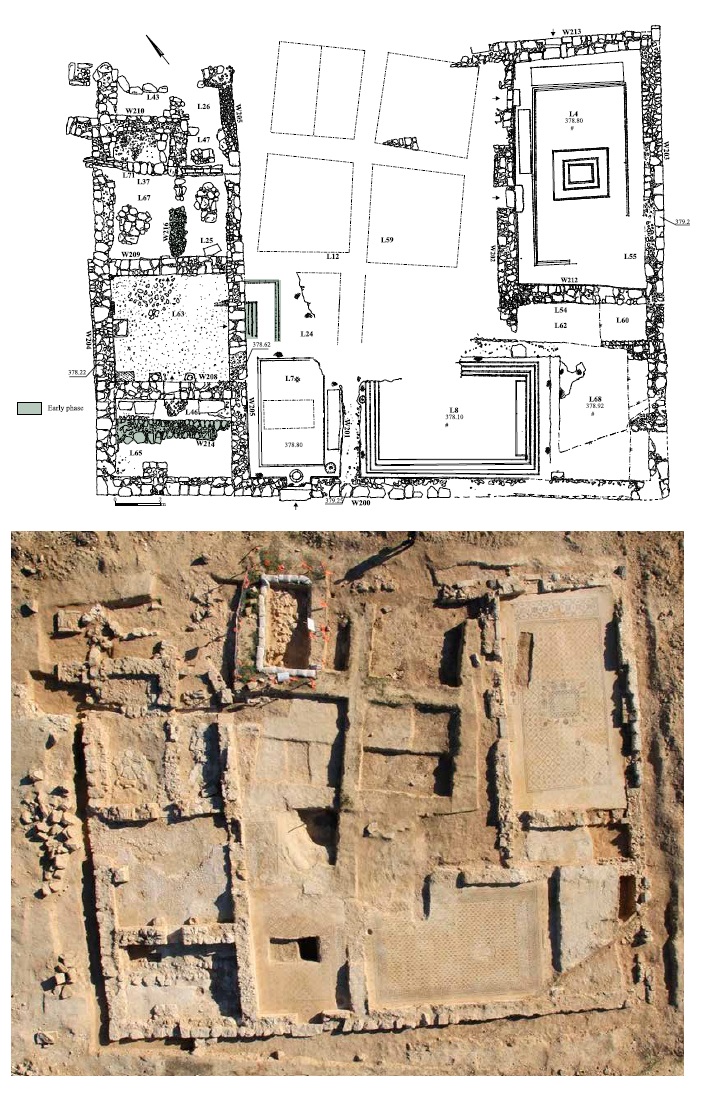
Description:
An earlier ecclesiastical phase, either a church or a monastic establishment, preceded the later complex at this location. Its remains lie beneath the western service wing, among them a mosaic in Room 63, and are dated to the late fourth or fifth century CE. Above these earlier structures, a sixth-century monastery measuring approximately 28 × 20 m was erected on an east–west alignment. The plan, progressing from west to east, comprised a west wing, an open central courtyard (L59), a narthex (L7), a prayer hall (L8), and a refectory (L4). Construction employed flint and chalk, with small stones embedded in a mud-based mortar. Two entrances to the complex were identified; one pierced the southern wall and opened into the narthex, which functioned as a vestibule. This space was paved with a continuous mosaic and carried a bilingual inscription in Greek and Christian Palestinian Aramaic (CPA). At the core of the building lay the open, beaten-earth courtyard (L59). The northern monastery wall is almost entirely lost, a condition likely caused by the collapse of a cistern beneath that sector. East of the narthex stood the prayer hall (L8; 5 × 8 m). Although the narthex provided the principal approach, a secondary access may have connected the prayer hall with the courtyard to the north. In the eastern part of the hall was a bema (L68), raised about 15 cm above the floor and separated by a chancel screen. A Greek inscription giving the date of the monastery’s construction was found within the mosaic pavement of this hall. North of the prayer hall and east of the courtyard lay the refectory (5.5 × 10 m), whose mosaic floor contained another Greek inscription set at its center. Additional rooms that may have served as monks’ cells have not survived; alternatively, the monks may have lived in the nearby village. Site plan and image source: Varga, Talgam 2023: 366–367, plan 1 and fig. 2. Further reading: Ustinova, Y. Greek Inscriptions from the Byzantine-Period Monastery at Ḥura. ‘Atiqot 110 (2023): 385–393. Varga, D. Hura, Nahal Shoqet, Preliminary report. Hadashot Arkheologiyot 127 (2015). http://www.hadashot-esi.org.il/report_detail.aspx?id=24838&mag_id=122 Vainstub, D., Sokoloff, M. and Varga, D. A New Christian Palestinian Aramaic Inscription in a Mosaic Pavement at Ḥura, Israel. Le Muséon 129, no. 3–4 (2016): 279–284. Varga, D. and Rasyuk, A. The Byzantine Monastery at Ḥura in the Northern Negev. Qadmoniot 50, no. 154 (2017): 109–118 (in Hebrew). Varga, D., Talgam, R. A Byzantine-Period Monastery at Ḥura. ‘Atiqot 110 (2023): 365. SEG 65 1766–1769. Negev (area of: Ḥura). Christian mosaic building inscriptions, 6th cent. A.D. A Digital Corpus of Early Christian Churches and Monasteries in the Holy Land: https://dig.corps-cmhl.huji.ac.il/epigraphicals/%E1%B8%A5ura-%E1%B8%A5orvat-%E1%B8%A5ura-khirbet-%E1%B8%A5ura-monastery