Farm, monastery(?) Complete
ID: 203
Building type: unknown
Context:
rural; monastic
Site:
Shelomi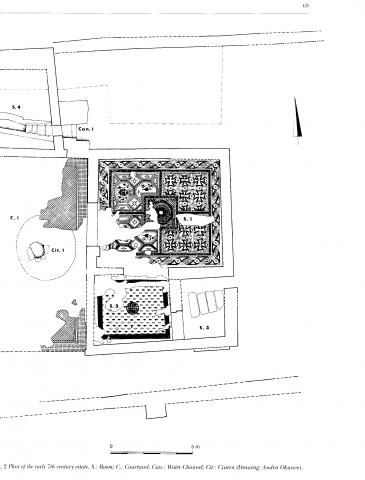
Description:
The complex comprises multiple chambers arranged around a courtyard equipped with a cistern and was most likely devoted to agricultural or industrial activities. The interiors were furnished with richly ornamented mosaic pavements. Despite this decorative program, there is no clear evidence for a church or chapel within the ensemble. Its final phase ended in a destructive fire. Dauphin links this conflagration to the early seventh-century Persian incursion into Palestine. In the aftermath, the courtyard was reconfigured and surfaced with a coarse white mosaic that carries a Christian Palestinian Aramaic inscription. Image source: https://dig.corps-cmhl.huji.ac.il/node/217, following Dauphin and Kingsley 2003. Inscriptions: - Two in Greek (CIIP V 6001, 6003) - One in Christian Palestinian Aramaic (CIIP V 6002) Further references: - CIIP V, chapter XVIII, Shelomi, pp. 133–135. - Dauphin, C. M., 2003. “A Byzantine Ecclesiastical Farm at Shelomi,” in: Ancient Churches Revealed, ed. Y. Tsafrir, Jerusalem: 43–48. - Dauphin, C. M. and Kingsley, S. A., 2003. “Ceramic Evidence for the Rise and Fall of a Late Antique Ecclesiastical Estate at Shelomi in Phoenicia Maritima,” in: One Land – Many Cultures. Archaeological Studies in Honour of Stanislao Loffreda OFM, eds. G. C. Bottini, L. Di Segni, and L. D. Chrupcała, Jerusalem: 61–74. - Tahan, H., Syon, D., 2010. “A Christian Inscription at Shelomi,” ‘Atiqot 62: 161–167. - Shelomi, A Digital Corpus of Early Christian Churches and Monasteries in the Holy Land: https://dig.corps-cmhl.huji.ac.il/node/217