Caesarea Complete
Localization
Site plan
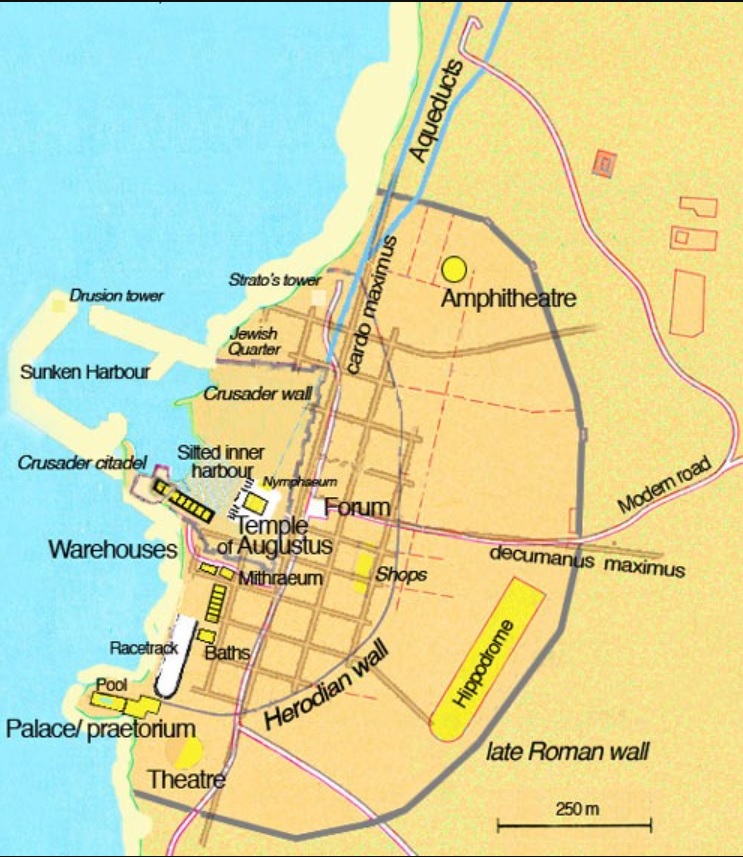
Description
On the Mediterranean littoral, Herod the Great founded a new urban center that he dedicated to his patron, Caesar Augustus, naming it Caesarea. The city followed an orthogonal street layout and, according to Flavius Josephus, included a harbor called Sebastos, a sanctuary of Rome and Augustus, a theater, a circus or amphitheater, and the king’s promontory palace. As the seat of the governor and a major urban hub, it also hosted a significant military encampment. The Bible refers to Caesarea on multiple occasions, including as the site of Paul’s imprisonment (Acts 10,1). Herod’s foundation rose on the site of an earlier settlement known as Straton’s Tower, traditionally attributed to the Sidonian king Straton and thought to date to the fourth century BCE. The locality enters the documentary record in 259 BC on a papyrus that notes it as a station on the Palestinian itinerary of Zenon, an agent of the Ptolemaic dioiketes. This Phoenician nucleus marked the beginning of the later city’s history. Caesarea’s mixed population generated persistent frictions from the outset, particularly over precedence between Jewish and non-Jewish communities. Josephus reports that in 66 CE violence culminated in the killing of twenty thousand Jews. Under Vespasian the city received colonial status and the formal title Colonia Prima Flavia Augusta Caesariensis, and in the reign of Severus Alexander it was raised to the rank of metropolis of the province Syria-Palaestina. Despite the devastation of 66, the Jewish community recovered and prospered in the third century CE. The “rabbis of Caesarea” were then active, among them Rabbi Abbahu, who instructed his daughters in Greek and maintained excellent relations with pagan authorities. Several Jews from Caesarea were interred at Beth Sheʿarim. The earlier catastrophe also appears to have affected the nascent Christian groups, and only from the later second century is a renewed Christian community with its own bishop attested. The city became an important Christian intellectual center. Origen established a renowned school, assembled an exceptional library, and produced the Hexapla. Eusebius, who served as bishop roughly between 315 and 339, was both an apologist and church historian; he recorded martyrdoms that took place in the amphitheater. After Christianity gained imperial predominance, a church was erected on the temple platform in place of Herod’s shrine to Roma and Augustus. The city also produced the historian Procopius of Caesarea, who comments on the presence and influence of the Samaritan community. Samaritans rose repeatedly against Roman authority in the fifth and sixth centuries; during Zeno’s reign, in 484, they assaulted Caesarea and set several churches ablaze. Procopius underscores the religious impetus of these and later Samaritan uprisings, at times with Jewish participation. In 614 a Persian force reached Caesarea, and the city capitulated with little resistance. Roman control briefly returned after 628, but in 641 or 642, following a seven-month siege, Caesarea surrendered to the Muslims. The ensuing centuries brought severe depopulation, natural damage, and spoliation of building stone, and the once-celebrated harbor installations fell out of use. In 1101 King Baldwin I of Jerusalem, aided by a Genoese fleet, took the city after a short siege and established a Crusader principality. The Mamluks under Sultan Baibars captured it in 1265 and demolished the fortifications to prevent its reestablishment as a Crusader bastion. The ancient toponym survives in Arabic as Qaisariya. By contrast, the modern label “Caesarea Maritima,” though widely employed today, appears not to have been used in antiquity. The site has been investigated for decades through surveys and excavations. In 1947 J. Ory partially exposed the synagogue in the so‑called Jewish Quarter; further work in this sector was directed by M. Avi‑Yonah and A. Negev between 1956 and 1962. Plan source: https://www.albert-tours-israel.com/single-post/2017/04/30/caesarea-the-capital-of-judea-for-over-600-years Further reading: Kenneth G. Holum, Avner Raban, "Caesarea: Introduction" The New Encyclopedia of Archeological Excavations In The Holy Land. 1993: 270-272. CIIP II, Caesarea, Introduction, p. 17-35.