Kalūta; Klūta; Klōta; Kālōtā; Kheurbet Kaloûti; Ḫirbat Kalūtī; Ḫirbat Kalūta Complete
ID: 69
Region/Province: Syria I
Localization
Site plan
Description
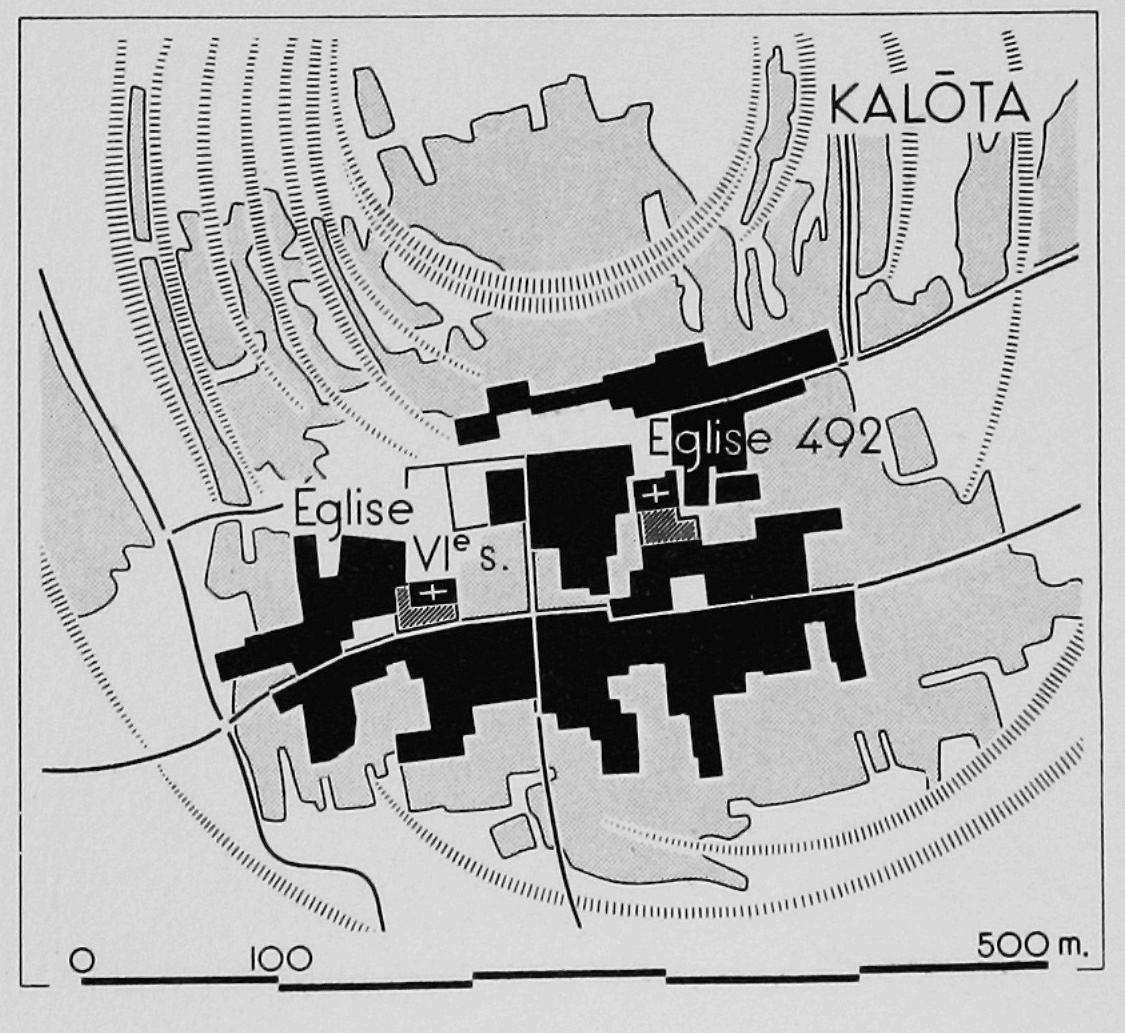
A village in Jabal Simʿān registered in TIB 15 on p. 1347 as Kalūta. Also spelt: Klūta, Klōta, Kālōtā, „Kheurbet Kaloûti“ (Ḫirbat Kalūtī), and Ḫirbat Kalūta. Klaus Peter Todt and Bernard Andreas Vest summarize in TIB 15 that the former expeditions recored around sixty houses in the village, among them a three-aisled basilica on top of an earlier polytheistic temple (later converted into a fort) on a hill outside the village, with an inscription dated 492 CE. The site also has the West Church. In addition to Greek and Syriac inscriptions there are also ubiquitous carvings of crosses. Inscriptions from houses give dates for the site's occupation in the 380s but the monumental architecture dates mainly from the sixth century Literature (after TIB 15, p. 1347): TIB 15 – Todt, K.P., Vest, B.A., Tabula Imperii Byzantini, vol. 15 (Vienna: Verlag der Österreichischen Akademie der Wissenschaften, 2014), p. 1347 (with further bibliography); H. C. Butler (ed.) Publications of the Princeton University Archaeological Expeditions to Syria in 1905–5 and 1909. Division II: Architecture, Section B: Northern Syria (Leiden: Brill, 1920), 315–322; Butler, H.C., Smith E.B., Early churches in Syria: fourth to seventh centuries (Amsterdam: Hakkert, 1969), 67; Lammens, H., "Le massif du Gabal Simʿan et les Yézidis de Syrie", in: Idem, "Notes de géographie syrienne", MUSJ 1 (1906), 368; Tchalenko, G. (ed.), Villages antiques de la Syrie du Nord: Le Massif du Bélus a l'époque romaine (Paris: P. Geuthner, 1953), vol. 1, 109, 201, note 2, 333 note 2, 247, 296 note 5, 349 note 5; Tchalenko, G. (ed.), Villages antiques de la Syrie du Nord: Le Massif du Bélus a l'époque romaine (Paris: P. Geuthner, 1953), vol. 2, Pl. LXXXVI, CXXIX; Tchalenko, G. (ed.), Villages antiques de la Syrie du Nord: Le Massif du Bélus a l'époque romaine (Paris: P. Geuthner, 1958), vol. 3, 121; Tchalenko, G., Églises syriennes à bêma: texte (Paris: P. Geuthner, 1990), 79–82; Strube, Ch., Baudekoration im Nordsyrischen Kalksteingebiet, vol. 1: Kapitell-. Tür- und Gesimsformen des 4. und 5. Jhs. n. Chr. (Mainz: Zabern, 1993), 18, 258–261; Strube, Ch., Baudekoration im Nordsyrischen Kalksteingebiet, vol. 2: Das 6. und frühe 7. Jahrhundert (Mainz: Zabern, 2002), 209–211, 213, 214; Tate, G., Les campagnes de la Syrie du Nord (Beirut: Presses de l’Ifpo, 2013), 102, 107, 179, 209. Inscriptions: The following abbreviations are used: PAES III B = W.K. Prentice (ed.), Publications of the Princeton University Archaeological Expeditions to Syria in 1905–5 and 1909. Division III: Greek and Latin Inscriptions. Section B: Northern Syria (Leiden: Brill, 1922). PAES IVB = E. Littmann (ed.), Publications of the Princeton University Archaeological Expeditions to Syria in 1905–5 and 1909. Division IV: Semitic Inscriptions. Section B: Syriac Inscriptions (Leiden: Brill, 1934). Greek inscriptions: PAES III B6 1191 = IGLS II 381 (inscription of a certain Antiochos, dated August 387 CE); PAES III B6 1192 = IGLS II 382 (Greek, from the East Church, dated 492 CE); PAES III B6 1193 = IGLS II 383 (Greek, ?to Seimos and Symbaitylos, ancestral gods, by son of Aphrodisios and his wife; from the 'temple' church); PAES III B6 1194 = IGLS II 384 and Tchalenko, G. (ed.), Villages antiques de la Syrie du Nord: Le Massif du Bélus a l'époque romaine (Paris: P. Geuthner, 1953), vol. 2, Pl. LXXXVI (Greek, ?the name Mariamē or a remembrance inscription for Maria; from a tomb); Syriac inscriptions: PAES IV B, 47–48, no. 54–55 (two Syriac inscriptions dated 543/544 and 545/546 CE, both from houses). Village plan after Tchalenko, G. (ed.), Villages antiques de la Syrie du Nord: Le Massif du Bélus a l'époque romaine (Paris: P. Geuthner, 1953), vol. 2, Pl. CXXIX.
Buildings:
Inscriptions:
No inscriptions found, click here to add new
No inscriptions found, click here to add new
No inscriptions found, click here to add new
No inscriptions found, click here to add new