Qāṭūra; Ḳāṭūrā; Fatura; Chattura; Fâtoûra Complete
ID: 77
Region/Province: Syria I
Localization
Site plan
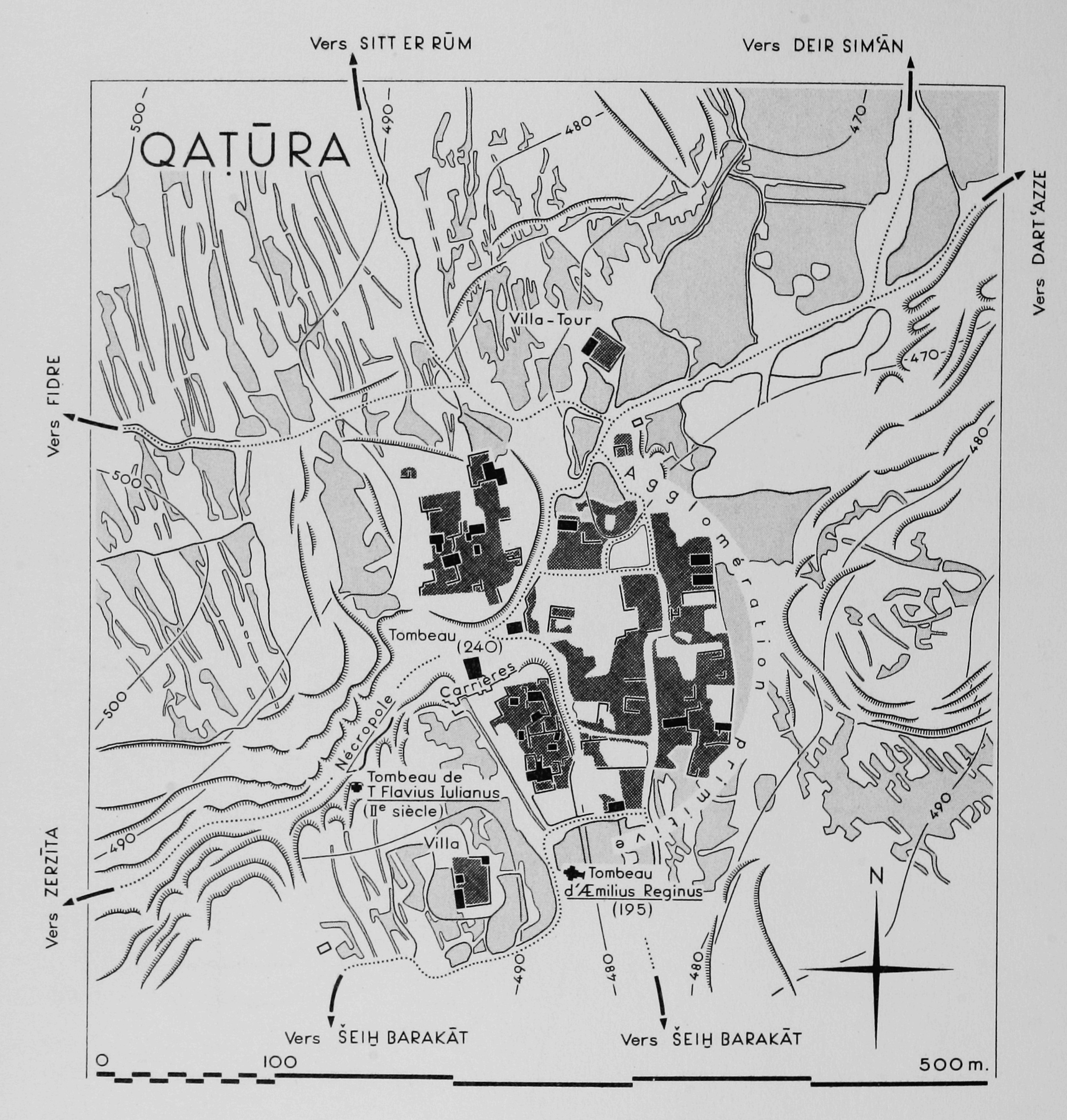
Description
A village in Jabal Ḥalaqa registered in TIB 15 on p. 1063 as Chattura. Also spelt Ḳāṭūrā, Fatura, Qāṭūra, and Fâtoûra. The village boasts a particularly rich collection of inscriptions, mainly in Greek and exhibited on individual houses and tombs. Some of them give dates which stretch across the period of fourth to mid-fifth century. The decreasing number of inscriptions afterwards, is usually considered as a sign of declining prosperity. In TIB 15, Klaus Peter Todt and Bernard Andreas Vest refer to earlier suppositions that the village originated already in the second century and its original population comprised a numer of settled Roman soldiers. This is based on finds of several dated epitaphs. A villa with a tower also existed to the north of the settlement. The Syriac inscriptions attested to a cult of Saint George and possibly name a deacon. Literature (after TIB 15, p. 1063): TIB 15 – Todt, K.P., Vest, B.A., Tabula Imperii Byzantini, vol. 15 (Vienna: Verlag der Österreichischen Akademie der Wissenschaften, 2014), p. 1063 (with further bibliography); Butler, H.C., Architecture and other Arts (Publications of an American Archaeological Expedition to Syria in 1899–1900 2, New York: Century, 1903), pp. 272–273; H. C. Butler (ed.) Publications of the Princeton University Archaeological Expeditions to Syria in 1905–5 and 1909. Division II: Architecture, Section B: Northern Syria (Leiden: Brill, 1920), pp. 249–250; Tchalenko, G. (ed.), Villages antiques de la Syrie du Nord: Le Massif du Bélus a l'époque romaine (Paris: P. Geuthner, 1953), vol. 1, p. 84, 189-194, 379, 381; Tchalenko, G. (ed.), Villages antiques de la Syrie du Nord: Le Massif du Bélus a l'époque romaine (Paris: P. Geuthner, 1953), vol. 2, Pl. LV, LVII, LVIII, LIX, LXII, CXXVII; Peña, I., Castellana, P., Fernandez, R., Les reclus syriens (Jerusalem: Franciscan Printing Press, 1980), p. 49, 340; Strube, Ch., Baudekoration im Nordsyrischen Kalksteingebiet, vol. 1: Kapitell-. Tür- und Gesimsformen des 4. und 5. Jhs. n. Chr. (Mainz: Zabern, 1993), p. 17; Gatier, P.-L., "Villages et sanctuaires en Antiochène. Autour de Qalaat Kalota", Topoi. Orient–Occident 7 (1997), 754; Tate, G., Les campagnes de la Syrie du Nord (Beirut: Presses de l’Ifpo, 2013), p. 103, 118, 119, 289, 290, 294. Inscriptions: For the clarity of presentation, editions are presented in abbreviated forms. Waddington = Waddington, W.H., Inscriptions grecques et latines de la Syrie (Paris: Firmin Didot Frères, Libraires-Éditeurs, 1870); AAES III = Prentice, W.K. (ed.), Greek and Latin Inscriptions (Publications of an American archaeological expedition to Syria in 1899-1900 3, New York: Century 1908); PAES IIIB = PAES IIIB–W.K. Prentice (ed.), Publications of the Princeton University Archaeological Expeditions to Syria in 1905–5 and 1909. Division III: Greek and Latin Inscriptions. Section B: Northern Syria (Leiden: Brill, 1922). Sixteen Greek inscriptions dating from the second, fourth and fifth century: PAES IIIB 1135–1137 = IGLS II 440–442 (three Greek inscriptions, dated 391, 466/467 C.E., house owners Fl. Phileon, Barapsas); Waddington 2704 = AAES III 116 = IGLS II 443 (invocation of Christ and One God by Thalasis, greeting to the reader); Waddington 2705a = AAES III 117 = IGLS II 444 (476 C.E.); Waddington 2705b = AAES III 117a = IGLS II 445 (476 C.E.); Waddington 2702 = AAES III 114 = IGLS II 446 (invocation of Zeus and good health, greetings to the reader; Waddington 2701 = AAES III 113 = PAES IIIB 1134 = IGLS II 447 (dated 240 C.E., dedication to Eros katachthnios or theoi katachthonioi); Waddington 2700 = AAES III 112 = IGLS II 448 (dated 195 C.E., consecration of a tomb to Aemilius Reginus, son of Ulpia Regilla and Aemilius Ptolemaius, adiutor of the cornicularii of the consular office); Waddington 2703d = AAES III 115A = PAES IIIB 1133 = IGLS II 449 (Funerary dedication by Aloulaios and Nikanor to their fathers and wives/Eudemō); Waddington 2703c = AAES III 115B = PAES IIIB 1132 = IGLS II 450 (epitaph for Augaieal > Augaios, son of Rhaaios?); Waddington 2703b = AAES 115C = PAES IIIB 1131 = IGLS II 451 (tomb for Barathes); Waddington 2703a = AAES III 115D = PAES IIIB 1130 = IGLS II 452 (name Barlaas); AAES III 115F = PAES IIIB 1129 = IGLS II 453 (date 122 C.E.?, poorly legible epitaph, Gaianos, son of Gadaios?, woman Barsimsēsa = Baršimšā?); AAES III 115E = PAES IIIB 1128 = IGLS II 454 (epitaph for Aldeios); CIL III 191 = Waddington 2699 = AAES III 111 = PAES IIIB 1127 = IGLS II 455 (bilingual Latin and Greek epitaph to T. Flavius Iulianus, veteran of Legio VIII Augusta and his wife Flavia Titia, greeting to a reader - "you too (shall die)" formula; very close translation of Latin into Greek expect for the description of dii manes/theoi katachthonioi). Two Syriac inscriptions dating from the fifth or sixth century: E. Littmann (ed.), Publications of the Princeton University Archaeological Expeditions to Syria in 1905–5 and 1909. Division IV: Semitic Inscriptions. Section B: Syriac Inscriptions (Leiden: Brill, 1934), no. 21 = CSLA.E04390 (Syriac graffito, invocation of Saint George); E. Littmann (ed.), Publications of the Princeton University Archaeological Expeditions to Syria in 1905–5 and 1909. Division IV: Semitic Inscriptions. Section B: Syriac Inscriptions (Leiden: Brill, 1934), no. 22 (graffito with a name); Plan of the village after Tchalenko, G. (ed.), Villages antiques de la Syrie du Nord: Le Massif du Bélus a l'époque romaine (Paris: P. Geuthner, 1953), vol. 2, Pl. LIX.