Kafr Daryān; Kpar Dārīn; Kpar Daryān; Kpar Deryān; Kafer Diâne; Kefr-Diyan; Kadr Dayān; Kefr Derian Complete
ID: 79
Region/Province: Syria I
Localization
Site plan
Description
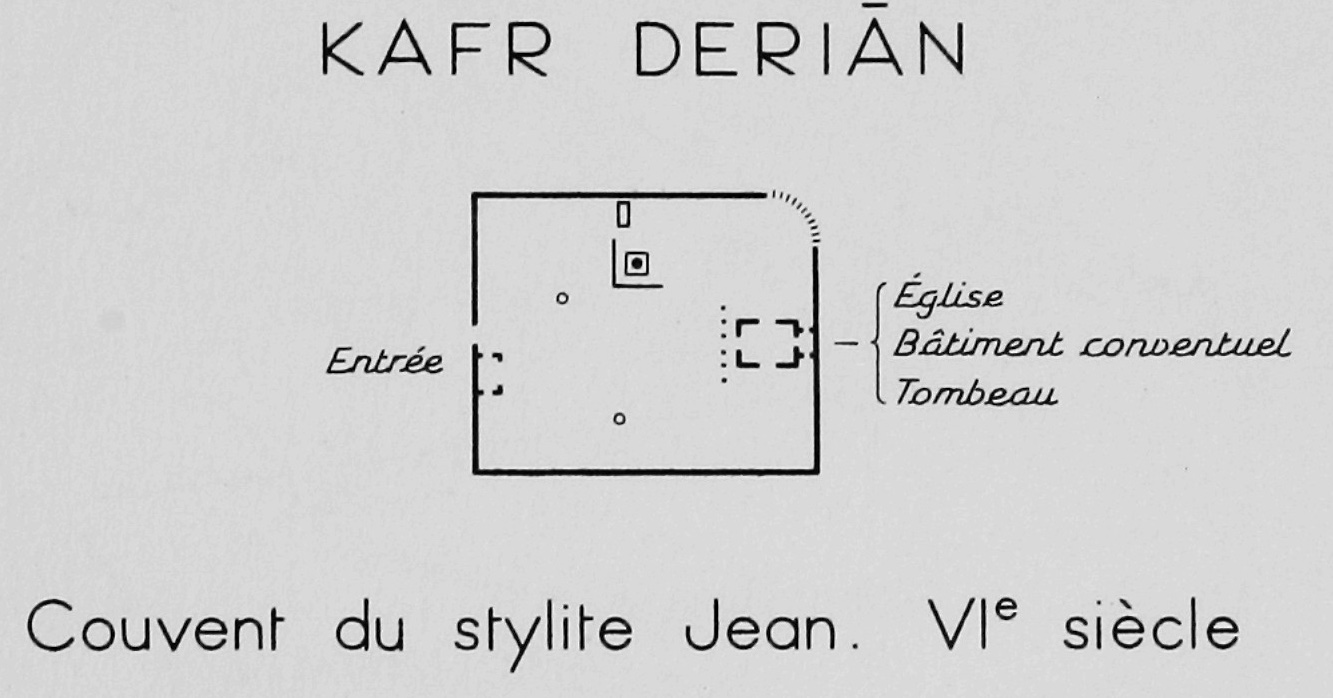
A village in Jabal Bārīšā registered in TIB 15 on pp. 1335–1336 as Kafr Daryān. Also spelt: Kpar Dārīn, Kpar Daryān, Kpar Deryān, Kafer Diâne, Kefr-Diyan, Kadr Dayān, and Kefr Derian. This is a monastic site well documented in literary sources for its allegiance with the non-Chalcedonian option. Klaus Peter Todt and Bernard Andreas Vest in TIB 15 emphasize the figure of its most prominent archimandrite, a certain Jonas, stylite, who subscribed the letter against the Tritheists dated 567 CE. (see also Chabot, Documenta ad origines Miaphysitarum illustrandas.., 164 (ed.) and 114 (tr.). Todt and Vest continue that the surveys encountered houses, quarries, a church ('Western Church', dated 529 C.E.), a monastery within an enclosure from the later sixth century with a stylite's column and a rock-cut sarcophagus, which could conceal a stylite's body. The monastery also had a large building with columns which could serve as the audience room for pilgrims flocking to see the holy man, a chapel dedicated to the Mother of God, and a crypt. Outside the monastic complex, one comes across a big basilica with columns and two towers. A large structure also lay to the south of the village. Literature (selected after TIB 15, pp. 1335–1336): TIB 15 – Todt, K.P., Vest, B.A., Tabula Imperii Byzantini, vol. 15 (Vienna: Verlag der Österreichischen Akademie der Wissenschaften, 2014), p. 1335–1336 (with further bibliography); Tchalenko, G. (ed.), Villages antiques de la Syrie du Nord: Le Massif du Bélus a l'époque romaine (Paris: P. Geuthner, 1953), vol. 1, p. 153, 171–172, 278–279; Tchalenko, G. (ed.), Villages antiques de la Syrie du Nord: Le Massif du Bélus a l'époque romaine (Paris: P. Geuthner, 1953), vol. 2, Pl. L/2 and LXXXVIII/1; Tchalenko, G. (ed.), Villages antiques de la Syrie du Nord: Le Massif du Bélus a l'époque romaine (Paris: P. Geuthner, 1958), vol. 3, p. 97; Peña, I., Castellana, P., Fernandez, R., Les stylites syriens (Milan: Centro propaganda e stampa, 1975), p. 34–35, 37, 53, 58–59, 95–100, 167–169; Peña, I., Castellana, P., Fernandez, R., Les cénobites syriens (Jerusalem: Franciscan Printing Press, 1983), p. 125; Peña, I., Lieux de pèlerinage en Syrie (Milan: Franciscan Printing Press, 2000), p. 13, 158-159; Callot, O., Gatier, P.-L., "Les stylites de l'Antiochène", Topoi Orient–Occident, Supplément 5 (2004), p. 576–577, 583. Inscriptions: Syriac inscriptions: Jarry, J., “Inscriptions arabes, syriaques et grecques du massif du Bélus en Syrie du nord”, Annales islamologiques 7 (1967), p. 147, no. 12 = CSLA.E01972 (Syriac, construction of a church dedicated to Mary); Greek inscriptions: IGLS II 578 (Greek, construction of a church by Kosmas and Iakobos under the presbyter Severus in 529 C.E.); IGLS II 579 (Greek, name Kesion?, on a rock-cut cistern – name of the owner); IGLS II 580 (Greek, on a limestone lintel at a structure situated to the south of the village, glorification of God); Jarry, J., “Inscriptions arabes, syriaques et grecques du massif du Bélus en Syrie du nord”, Annales islamologiques 7 (1967), p. 186, no. 111 (Greek, very fragmentary, probably a verse inscription commemorating the construction of a building); Seyrig, H., "Inscriptions grecques", in: Tchalenko, G. (ed.), Villages antiques de la Syrie du Nord: Le Massif du Bélus a l'époque romaine (Paris: P. Geuthner, 1958) vol. 3, p. 28, no. 27a, cf. Tchalenko 1953, vol. 1, p. 279 (Greek, boundary stone of Kafr Daryān and Ma‘az/Mogiza, includes a Trisagion prayer). Plan of the stylite's sanctuary after Tchalenko, G. (ed.), Villages antiques de la Syrie du Nord: Le Massif du Bélus a l'époque romaine (Paris: P. Geuthner, 1953), vol. 2, Pl. L/2 .
Buildings:
Inscriptions:
No inscriptions found, click here to add new