Synagogue Complete
ID: 130
Building type: basilical synagogue
Context:
urban/rural
Site:
Qasrin; Katzrin; Qatzrin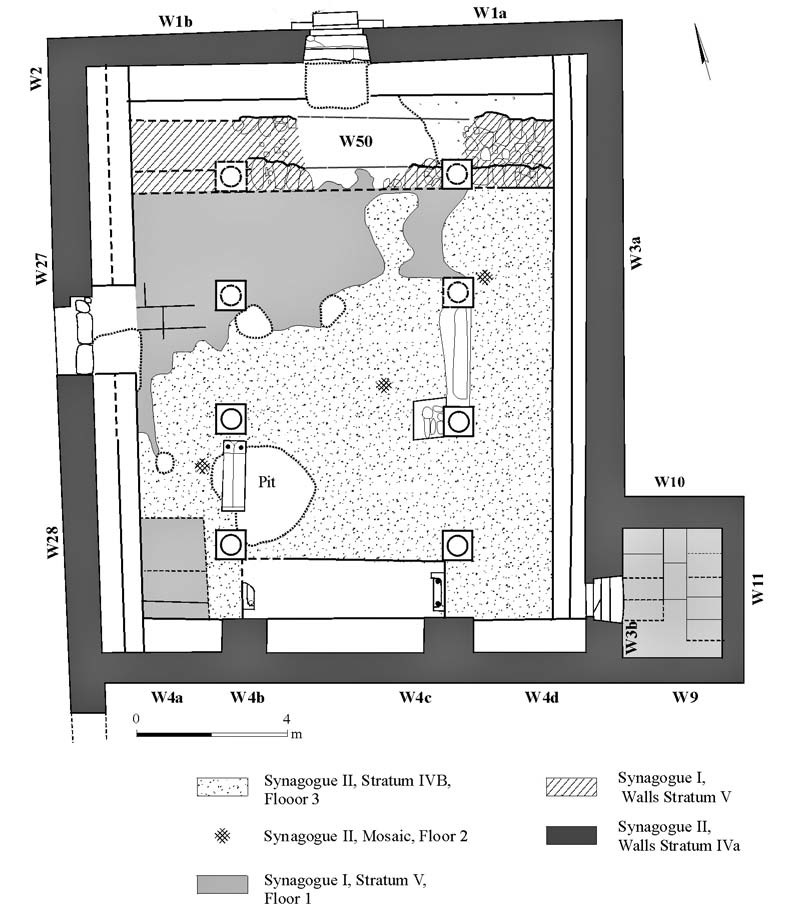
Description:
Aligned on a north–south axis and approximating a rectangle, the synagogue underwent three principal construction and refurbishment stages. Its walls consist of finely worked basalt ashlar, while the interior surfaces were coated with lime plaster, whitewashed, and in places accented with red painted bands. Along the perimeter, two tiers of stepped benches were installed. The earliest phase, placed in the early third to fourth centuries CE, comprised a hall articulated into a central nave flanked by two aisles. This arrangement was created by two rows of three columns, with two engaged pillars incorporated on the northern side. Beneath the later, larger Torah shrine, excavations revealed the remains of an earlier aedicule set against the inner southern wall oriented toward Jerusalem. A second building phase produced an irregular rectangular structure faced externally with smoothed basalt ashlar. In this configuration, the north wall preserves a single, centrally positioned doorway 3.40 m high. The doorframe—jambs and lintel—bears a decorative ensemble consisting of a plain architrave, a convex frieze, and a crowning cornice. Internally, the space was again organized into a nave, approximately 6 m wide, and two aisles, each about 3.5 m wide, this time by two rows of four columns, supplemented by two square engaged columns affixed to the southern wall adjacent to the Torah shrine. Long basalt beams recovered in debris from the 1975–1977 excavations indicate a roof carried on stone beams, a method consistent with neighboring domestic and regional buildings; abundant ceramic roof tiles from the destruction layer suggest these beams were covered with tiles. Approximately 180 coins were retrieved from fill between a bench and the northern wall. Of the 64 identifiable pieces, all date to the fifth century CE, which indicates repair activity—at least along the northern sector—during that period. The final stage introduced further alterations, and there may have been an emergency remodeling in the late sixth to early seventh centuries CE. The synagogue remained standing into the seventh and early eighth centuries, and it was likely destroyed in the earthquake of 749. The structure was reoccupied in the thirteenth to fifteenth centuries CE, when it was adapted for use as a mosque. A small corpus of inscriptions—four(?) in Aramaic and one in Hebrew—was found on stones reused in secondary contexts within the synagogue and in buildings nearby; three of these inscriptions have been edited. Image source: Hachlili 2013, p. 85 Further reading: - Hachlili, R. 2013. Ancient Synagogues – Archaeology and Art: New Discoveries and Current Research. Leiden and Boston, 79–110. - Urman, D. 1995. Public Structures and Jewish Communities in the Golan Heights. In: Ancient Synagogues, ed. D. Urman and P. Flesher, Leiden, 463–481. - https://synagogues.kinneret.ac.il/synagogues/qasrin/