Synagogue Complete
ID: 133
Building type: basilical synagogue
Context:
rural
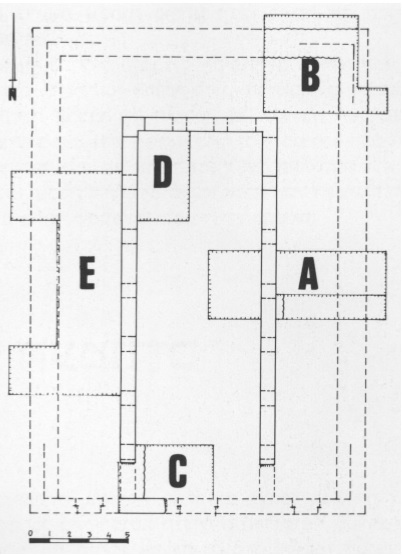
Description:
The synagogue was conceived in a basilica-like plan and exhibited workmanship of high quality, evident both in its mosaic pavements and in a monumental façade lintel carved with lions. In the western sector (Area E), a mosaic floor was uncovered in notably good condition, whereas elsewhere the pavement survives only in isolated patches. The northern portion of the floor consisted of plain white tesserae, while the southern portion carried polychrome geometric ornament in black, white, red, blue, and orange. Within this southern zone, a damaged Aramaic inscription was found, of which five lines are preserved. Benches likely lined the interior walls. Before systematic excavations were undertaken, E. Sukenik discovered an inscribed stone slab associated with the building. Evidence for the date of construction comes from four third-century coins recovered beneath the mosaic in Area D, which fix the time of the synagogue’s erection. As L. I. Levine has argued, the synagogue at Horvat Ammudim probably functioned for only about a century. Finds resting above the pavement predominantly belong to the Early Byzantine period, there is no sign of a violent end, and the site appears to have been abandoned toward the close of the fourth or the opening of the fifth century. Source of plan: Plan and Excavations Area | Levine 1980: 108 © synagogues.kinneret.ac.il Further reading: - Levine, L. I. 1993. “Horvat Amudim.” The New Encyclopedia of Archeological Excavations in the Holy Land, vol. 1. Jerusalem, 55–56. - Milson, D. W. 2007. Art and Architecture of the Synagogue in Late Antique Palestine. In the Shadow of the Church, Leiden, 394–385. - https://synagogues.kinneret.ac.il/synagogues/ammudim/