Synagogue Complete
ID: 149
Building type: basilical synagogue
Context:
rural
Inscriptions:
Description:
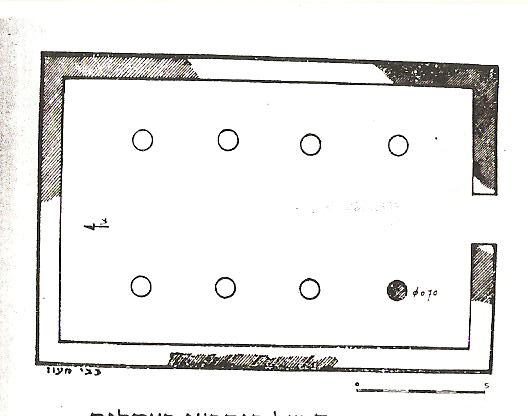
In 1976, the remains of a sizable communal structure—possibly a synagogue—were announced at ʿAsaliyye. When D. Urman inspected the site that same year, he reported that the only substantial feature he could confirm was a stretch of wall, likely the northern side, preserved to a notable height. This segment, about six meters long and constructed of dressed basalt blocks, was subsequently incorporated into a Syrian (pre)modern dwelling. Overall preservation at the locality is poor. Architectural fragments, including Ionic and Doric capitals, lie dispersed across the area. Among the most consequential portable finds are a basalt door lintel carved with a relief of an aedicule and flanked by a seven-branched candelabrum on each side, as well as a fragment of an Aramaic inscription on a stone table. Z. U. Ma’oz published a reconstruction presenting the building as a rectangular, basilical synagogue and offered a visualization of the entrance employing the aforementioned lintel; he also proposed a sixth-century CE date on the basis of comparison with the synagogue at Qasrin. Urman criticized these reconstructions, judging them to be “based more on imagination than on evidence found on the site” (Urman 1995: 487). Source for the plan: Maoz 1979. Further reading: Maoz, Z.U. 1979. “Asaliyeh—A Jewish Village and Ancient Synagogue in the Golan.” Teva va-Aretz 21, 185–188 (Hebrew). Urman, D. 1995. “Public Structures and Jewish Community in the Golan Hights.” In: D. Urman and P.V.M. Flesher (eds.), Ancient Synagogues: Historical Analysis and Archaeological Discovery, vol. 2. Leiden, 485–489. Milson, D.W. 2007. Art and Architecture of the Synagogue in Late Antique Palestine. In the Shadow of the Church. Leiden, 308. https://synagogues.kinneret.ac.il/synagogues/aasaliya/