Tiberias Complete
Localization
Site plan
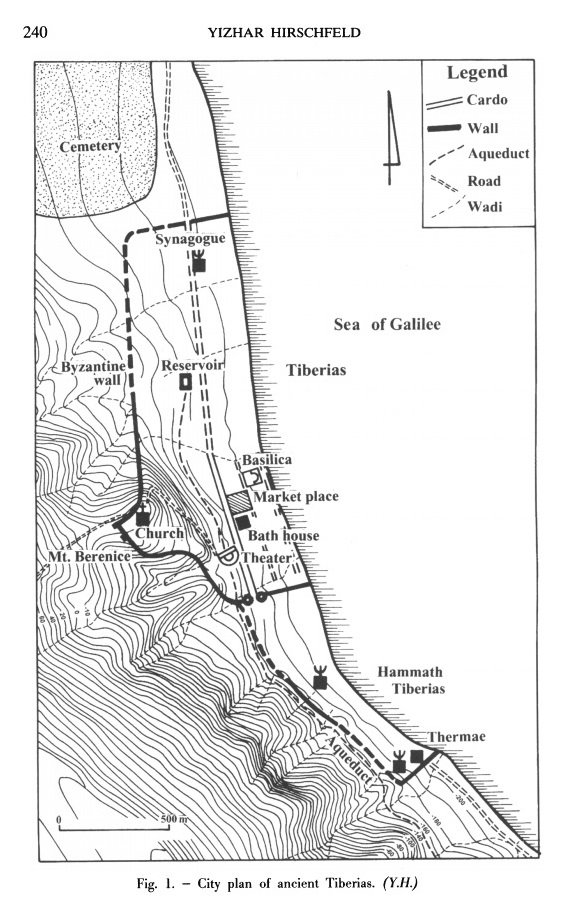
Description
Situated on the western margin of the Sea of Galilee, the city lay just north of the Hammath Tiberias hot springs. Its western limit was defined by Mount Berenice, which rises roughly 200 meters above the lake’s surface. Herod Antipas established the settlement and designated it the administrative center of his realm, giving it a name in honor of the emperor Tiberius. Under Emperor Elagabalus (218–222), the city attained the rank of a Roman colony. At around this time, the principal Jewish governing bodies were transferred from Sepphoris to the city, including the Sanhedrin. Thereafter it functioned as the foremost Jewish center for Palestine and the Diaspora and flourished through Late Antiquity. In the sixth century, the Academy (Yeshiva)—which succeeded the Sanhedrin as the highest religious authority—was founded there. The Jewish community continued to be active well after the Muslim conquest, at least into the tenth century. Subsequently, worsening security in the region contributed to demographic decline. A destructive earthquake in 1033 leveled the city, and during the Crusader period the settlement shifted north to the area occupied by the modern town. Archaeological inquiry has been underway since the nineteenth century, revealing numerous elements of the ancient urban landscape: a bath complex, a marketplace, a colonnaded street, a Roman basilica later adapted as a church, a large exedra, additional public edifices, and domestic quarters. In 1978–1979, A. Berman uncovered a synagogue—one of what must once have been several—in the northern sector of the site. Site Further reading: Y. Hirschfeld, “Imperial Building Activity During the Reign of Justinian and Pilgrimage to the Holy Land in Light of the Excavations on Mt. Berenice, Tiberias,” Revue Biblique 106, no. 2 (1999): 236–49, http://www.jstor.org/stable/44089438. Further reading: Y. Hirschfeld, G. Foerster, F. Vitto, “Tiberias,” in E. Stern (ed.), The New Encyclopedia of Archaeological Excavations in the Holy Land, vol. 4, pp. 1464–1473.