Synagogue Complete
ID: 11
Building type: basilical synagogue
Context:
urban
Site:
Hammath Tiberias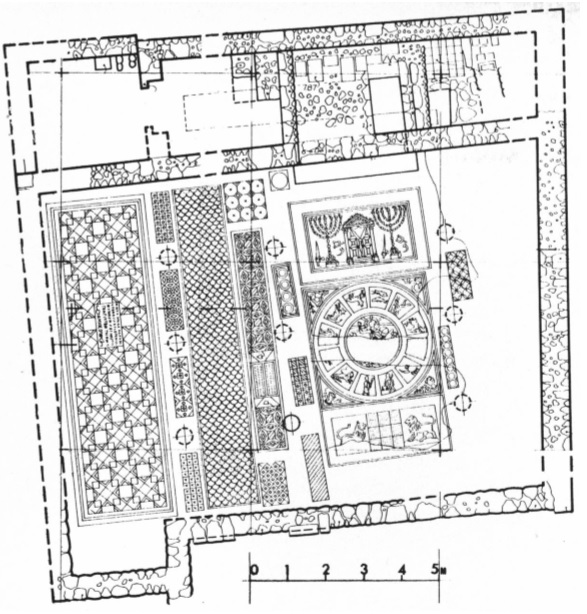
Description:
The architectural history of the complex unfolds in several phases. The earliest substantial stratum, Level III, belongs to the 1st–2nd centuries CE. It comprised a public structure organized around a central courtyard with rooms on at least three sides and two entrances opening to the south. Although it may already have functioned as a synagogue, this identification remains uncertain. Upon this earlier fabric rose the Level II B–A synagogue, a rectangular edifice measuring approximately 15 by 13 meters. Three transverse rows of three columns each divided the hall into four bays; the second bay from the west, the broadest, served as the nave. The main space—nave and aisles alike—was laid with a polychrome mosaic of notable artistic quality. In the nave the mosaic was arranged in three panels. The southern panel depicts the Ark of the Law, flanked by menorahs and ritual implements (lulav, ethrog, shofar, and incense shovel). The central panel presents the zodiac encircling the sun god Helios in his chariot; part of this composition was destroyed when a wall of the later Level I was built. In its corners appear four female busts symbolizing the seasons, with both the zodiac signs and seasonal emblems labeled in Hebrew. The northern panel bears a dedicatory inscription in Greek, guarded by two lions. Additional inscriptions—one in Aramaic and two in Greek, one of the latter concluding with the Hebrew word “shalom”—were set in the two eastern aisles, where geometric ornament predominates. The Level II A mosaic is assigned to the 4th century CE. This phase ended in the 5th century CE with the construction of the larger synagogue (Level I B), a basilican building with a central nave flanked by two aisles, a scheme characteristic of many sacred structures in the 5th and 6th centuries. Three principal entrances opened into the main hall from the north, and three steps ascended from the nave to a raised apse. At the beginning of the Umayyad period the building was remodeled (Level I A). All standing remains were destroyed in the mid-8th century CE, at the outset of Abbasid rule, and the site was not rebuilt thereafter. Inscriptions - Nave mosaic: Hebrew labels for the seasons and the zodiac signs (IIP: tibe0001–2; tibe0007–9). - Nave mosaic: an Aramaic blessing naming donors—Maximos, Aboudemos, Zoilos, Ioullos, Kalinikos, Porfuturos, Severos, Siortasis—and the Patriarchs (tibe0004). - East aisle mosaic: a Greek text, “Severos, pupil of the illustrious Patriarchs, completed the construction; praise to him and to Julius” (tibe0005). - East aisle mosaic: an Aramaic commemoration for those who offered charity in this holy place (tibe0003). - East aisle mosaic: a Greek commemoration of Profuturos, who built an aisle (stoa), concluding with the Hebrew “Shalom” (tibe0006; also catalogued as tibe0014). Site plan Level II B–A, Mosaic Floor Sketch, in Dothan 1968: 121. Courtesy of the Israel Exploration Society. See synagogues.kinneret.ac.il: https://synagogues.kinneret.ac.il/synagogues/hammath-tiberias/ Further reading Dotan, M. 1993. “Hammat Tiberias.” In The New Encyclopedia of Archaeological Excavations in the Holy Land, vol. 2, 573–577.