Hammath Tiberias Complete
Localization
Site plan
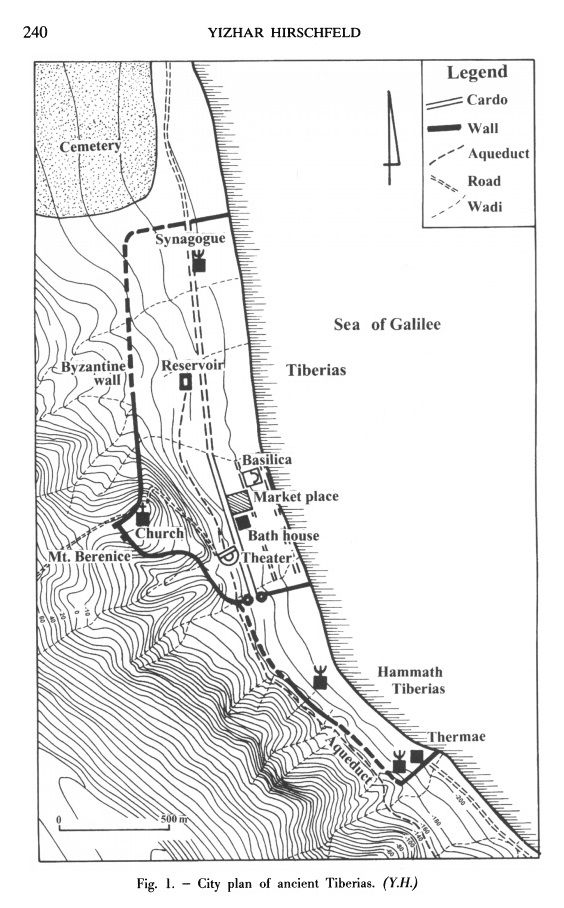
Description
Archaeological investigations at Hammath Tiberias have identified two synagogues. The northern synagogue was excavated in 1921 by N. Slouschz, while the southern building—positioned beside the hot springs and adjacent to the city wall—was uncovered in 1961–1962 under the direction of M. Dothan. The site occupies the western shore of the Sea of Galilee, with Hammath lying immediately south of Tiberias and noted for its thermal springs. Originally, Hammath and Tiberias functioned as two independent, walled cities; beginning in the first century AD they formed a unified urban entity. The fortunes of Hammath rose and fell in tandem with those of Tiberias. In the third century AD, Tiberias served as the seat of the Great Yeshiva and the Sanhedrin. Although both centers are said to have entered a period of decline following the abolition of the patriarchate around 429 AD, they retained importance through Late Antiquity, a status reinforced by the locale’s recreational character. A Jewish community continued to reside at Hammath well into the Islamic period. Plan source: Hirschfeld, Y. 1999. Imperial Building Activity During The Reign Of Justinian And Pilgrimage To The Holy Land In Light Of The Excavations On Mt. Berenice, Tiberias, Revue Biblique, vol. 106, no. 2, 236–249, http://www.jstor.org/stable/44089438. Further reading: Dotan, M. 1993. “Hammat Tiberias” in: The New Encyclopedia of Archeological Excavations in the Holy Land, vol. 2, 573–577. https://synagogues.kinneret.ac.il/synagogues/hammath-tiberias-north/ https://synagogues.kinneret.ac.il/synagogues/hammath-tiberias/