Synagogue Complete
ID: 21
Building type: basilical synagogue
Context:
rural
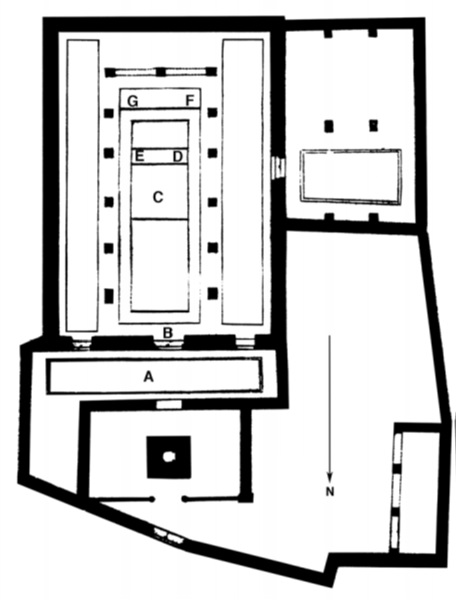
Description:
Access from the north led through an atrium into a narthex, beyond which lay a basilican hall articulated by a triple colonnade and accompanied by an annex to the southwest. All rooms were paved with mosaics, and a second storey probably rose above the ground level. The southern portion of the pavement is missing; it may once have accommodated an apse for a Torah shrine. Within the narthex, a menorah appears in mosaic alongside an Aramaic inscription (A). Immediately inside the doorway, along the north wall, a two-line Aramaic text is preserved (B). The principal hall, 15 m in width and 21 m in length, is divided into a central nave and two flanking aisles. The nave’s pavement presents a striking polychrome program arranged in three panels. The northernmost and largest field displays geometric motifs together with animals. The central field contains a zodiac whose elements are identified by Hebrew labels (C); Helios occupies the center in a chariot, while the four Seasons appear in the corners. Many of the zodiac figures seem to have been deliberately defaced in antiquity in an iconoclastic act, with incidental damage to the accompanying labels. The southern field depicts a Torah shrine flanked by a pair of seven-branched, lamp-bearing menorahs, each surmounted by an Aramaic dedication (F, G). Beneath the shrine stand two lions and an orant, interpreted as Daniel in the lions’ den; an inscription to the right of the figure confirms this identification and is accompanied by an additional dedicatory text (D). Further Aramaic dedications are positioned to the left of the scene (E). The hand responsible for inserting the nave inscriptions appears to differ from that of the mosaicist who designed and executed the figural and ornamental program, with the exception of the zodiac labels. The mosaic “carpet” is coherently designed and executed with considerable skill, whereas the dedicatory texts are fitted into residual spaces between and around the scenes and exhibit errors in orthography and letter formation. Plan source: CIIP IV, fig. 2730.A Further references: CIIP IV 2730–2736 Na’aran, in: Stern, Ephraim (ed.), New Encyclopedia of Archaeological Excavations in the Holy Land, 3, 1993: 1075–1076. Milson, D. W. 2007. Art and Architecture of the Synagogue in Late Antique Palestine. In the Shadow of the Church, Leiden, 410–411. Naveh, J. 1978. On Stone and Mosaic: The Aramaic and Hebrew Inscriptions from Ancient Synagogues, Tel Aviv, 93–102 (58–67). Werlin, S. H. 2015. Ancient Synagogues of Southern Palestine, 300–800 C.E.: Living on the Edge, Leiden, 36–56.