Synagogue Complete
ID: 110
Building type: basilical synagogue
Context:
urban/rural
Description:
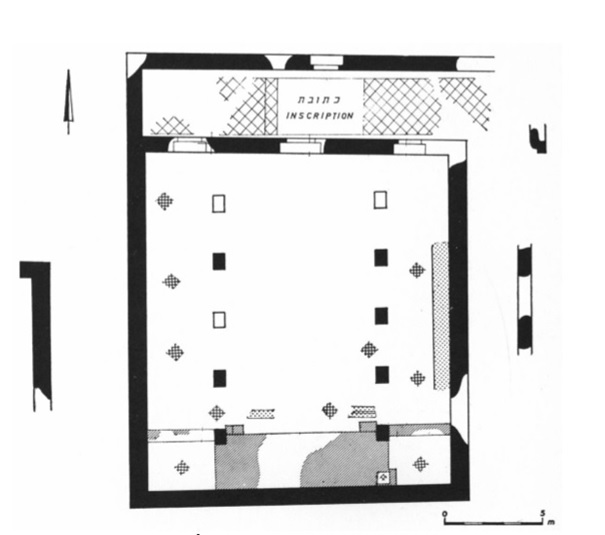
At minimum, the synagogue underwent three distinct construction campaigns. Its end came in the 7th century, when the building was destroyed—perhaps by an earthquake. Excavation of the collapse layer yielded roof tiles and several triple-handled glass polycandela with bronze chains. Before its destruction, a late phase (Phase III, late 5th century AD or thereafter) introduced a chancel screen, added a narthex that incorporated mosaic inscriptions, and involved a comprehensive replastering of the interior surfaces. An earlier renovation (Phase II, late 4th–5th century AD) installed a raised platform (bema) along the southern side; at that time, the walls and columns were coated with plaster and decorated with red and green vegetal motifs together with inscriptions. The earliest phase (Phase I, 4th century AD) comprised the construction of a three-aisled hall. Inscriptions (as reported by Misgav 2015) 1. A Hebrew halakhic text set in mosaic at the center of the narthex. 2. An atypical Aramaic dedication at the eastern end of the narthex, referring to the rebuilding of the Temple. 3. A list of annual fast days written on a plastered wall or column. 4. A halakhic inscription, encircled by the wretch, on a plastered wall or column. 5. A large dedicatory text naming about thirty donors, framed in a tabula ansata and bordered by the wretch, preserved on the primary plaster of a wall/column, with a mirrored impression on the reverse of the secondary plaster. 6. Portions of a lengthy dedicatory inscription on the second plaster layer, featuring distinctive formulations. 7. Fragments of a text in unusually large letters on the primary plaster of a wall/column, with a mirrored impression on the back of the secondary plaster; possibly part of a prayer, a solicitation, or even a magical incantation. 8. Sections of a roster of the priestly courses (mishmarot) serving in the Temple on the primary plaster of a wall/column, with a mirrored impression on the reverse of the secondary plaster. 9. Fragments of an inscription in black letters (perhaps on the secondary layer); the genre is unknown. 10. Miscellaneous fragments, some preserving multiple words and others only single letters; several survive as mirror impressions on the back of the second layer of plaster. Items 4–10 are unedited and therefore not included in our database. For further reading: - Milson 2007: 456–461. - Misgav, H., “The List of Fast Days from the Synagogue of Rehov,” Israel Museum Studies in Archeology 7 (2015): 14–23. - Vitto, F., “Wall Paintings in the Synagogue of Rehov: An Account of Their Discovery,” Israel Museum Studies in Archeology 7 (2015): 2–13. - Chaim Ben David, “The Rehov Inscription: A Galilean Halakhic Text Formula?” in Chaim Ben David, Albert I. Baumgarten, Hanan Eshel, Ranon Katzoff, Shani Tzoref (eds.), Halakhah in Light of Epigraphy, Göttingen: Vandenhoeck & Ruprecht, 2011. - https://synagogues.kinneret.ac.il/synagogues/rehob/