Nestorian(?) monastery Complete
ID: 188
Building type: chapel
Context:
monastery; monastic
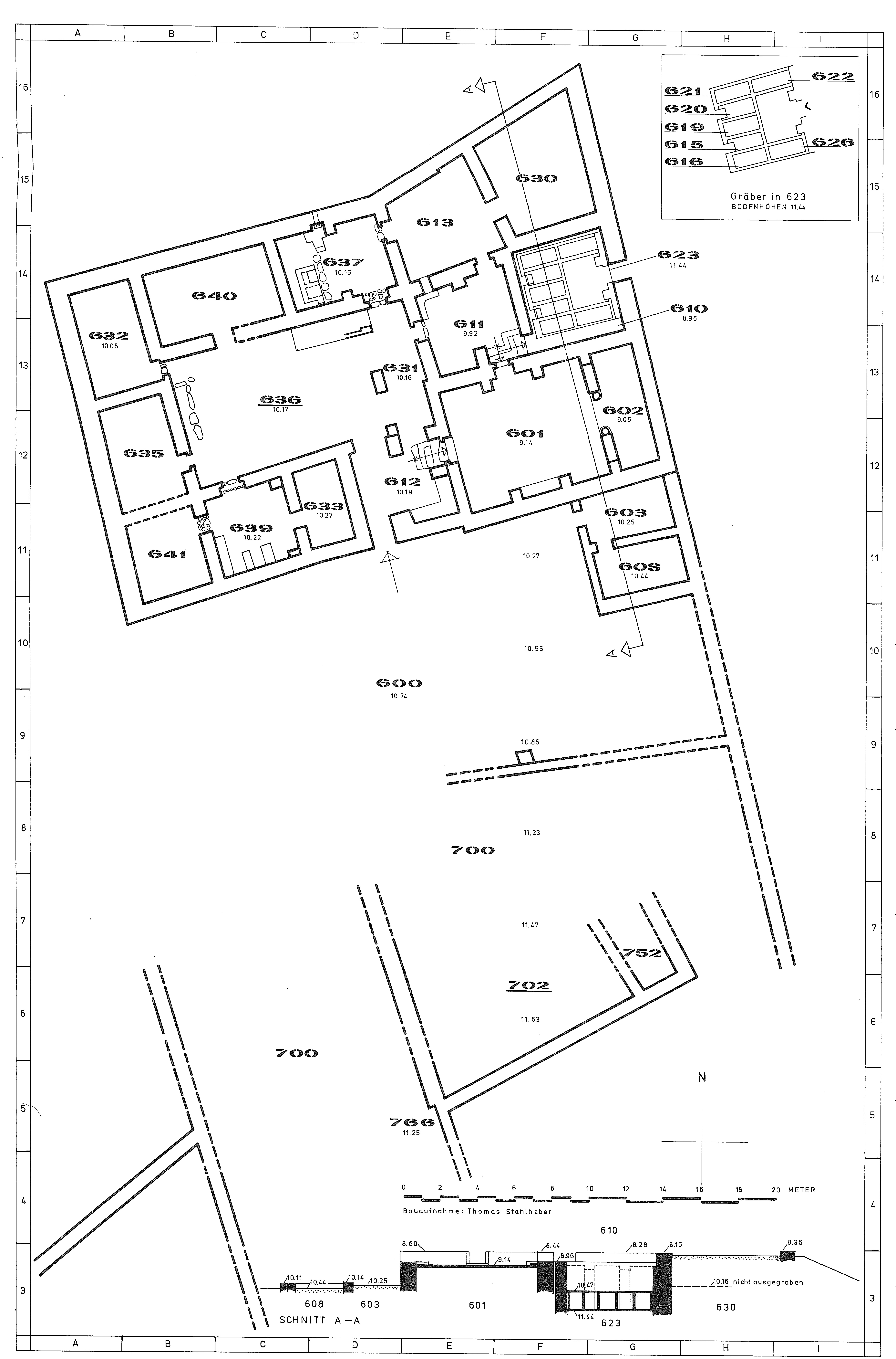
Description:
On the southwestern margin of Tel Masos (Area D) stands a monastic compound whose plan centers on a courtyard flanked by multiple rooms and a principal sanctuary. The chapel, placed in the southeastern sector and measuring approximately 10 by 6.5 m, was characterized by the excavators as exhibiting a Syrian stylistic idiom. Around the court, seven rooms line the western and northern sides, with four additional chambers along the east. In the northeastern corner of the courtyard, a room yielded two ovens together with domestic ceramics, leading to its identification as the kitchen. Immediately north of the chapel lies a burial chamber containing seven tombs. This space could be reached both from within the monastery and through an opening in the complex’s eastern wall. The graves were cut and originally sealed by stone slabs that have since weathered away. It is possible that walls adjacent to the chapel collapsed into this area, and that some inscribed elements originated from this fallen masonry. Finds related to Syriac script were recovered in successive excavation seasons. In 1974, fragments of plaster bearing Syriac letters were discovered within the crypt; they likely represent the remains of a memorial tablet (Ger. Totengedenktafel). The previous year, five stones inscribed with Syriac characters were collected from the debris of the two rooms adjoining the crypt and from the chapel itself, though their original positions and functions remain unknown. All of these inscriptions are fragmentary and poorly preserved, making them difficult to read. Duncan’s study (2008) of the monastery’s architectural and religious context concluded that the inscriptions do not allow a precise determination of the Byzantine complex’s affiliation. Whether the texts are East Syrian or West Syrian (Nestorian), they nevertheless indicate that the monastery’s inhabitants were not local. The building’s design and parts of its decorative program likewise point to non-local influences. The entire complex is roughly rectangular, measuring about 30 by 20 m. Source of images Fritz, V.; Kempinski, A. 1983: vol. I, p. 139, figs. 17–19; vol. III, Plan 25. Further references - Bar-Asher, M. 1977. Palestinian Syriac Studies. PhD thesis, Department of Linguistics, Hebrew University, Jerusalem [in Hebrew; unpublished], nos. 144–145. - Duncan, C. E. 2008. An investigation into the Geography, Theology, and Architecture of the Byzantine Monastery at Tel Masos. MA thesis supervised by Jodi Magness, University of North Carolina at Chapel Hill. - Figueras, P. 1995. Monks and Monasteries in the Negev Desert, Liber Annuus 45, 401–450. - Fritz, V.; Kempinski, A. 1983. Ergebnisse der Ausgrabungen auf der Hirbet el-Msas (Tel Masos) 1972–1975: Teil I: Textband. Teil II: Tafelband. Teil III: Pläne. Wiesbaden: Harrassowitz.